BOTANICAL IDENTITY
The right name is the first step.
Also known as: Anise
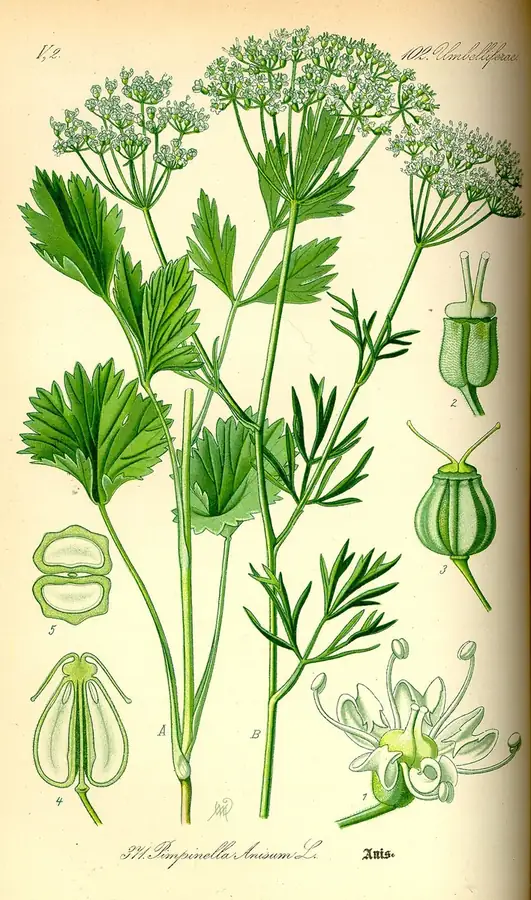
Anise, Pimpinella anisum, is not star anise, Illicium verum.
An illustration is not enough to identify a plant for consumption. Do not forage for a species based solely on this profile.
01 · UNDERSTAND
Properties & uses.
Cough associated with a cold
Traditional use to facilitate expectoration.
Read the sourceThe traditional uses described are not clinical proof of effectiveness. Evidence for one preparation cannot automatically be applied to another.
02 · UNDERSTAND THE ACTION
How does the plant act?
Anise is documented through its fruits, commonly called seeds. Its digestive and expectorant uses remain traditional. The presence of an aromatic fraction provides pharmacological research directions, but also requires the fruit to be distinguished from the concentrated essential oil. Certain activities observed in animals, particularly hormonal activities, do not constitute benefits to seek in humans. The data justify neither a course of hormonal treatment nor a concentrated preparation for an infant.
Constituents to know.
Their presence and quantity depend on the plant part and preparation.
- Trans-anethole
- Major constituent of anise essential oil. Effects studied with this substance or the oil do not automatically transfer to a fruit infusion.Read the reference
Digestive spasms, bloating and flatulence
Traditional use targets mild digestive symptoms. It does not demonstrate efficacy in inflammatory bowel disease or an obstruction.
Read the referenceExpectoration during a cold
The fruit has a traditional use for cough associated with a cold, without evidence of viral eradication.
Read the referenceExperimental hormonal activity
Experiments in rats observed estrogen-like activity at high exposure. This result is a pharmacological observation, not a clinical indication.
Read the referenceWhat this means for preparation.
Check for Pimpinella anisum, the fruit and the preparation. Star anise belongs to another genus and must not be assigned the properties in this profile merely because of a similar name.
03 · EXAMINE THE EVIDENCE
What the research shows.
A laboratory or animal result alone does not demonstrate a benefit in humans. Each result must be read alongside the preparation studied and its limitations.
Mechanisms explored, without established human benefit
- Type of research
- EMA assessment of experimental data and long-standing use.
- Preparation concerned
- Fruits, essential oil and constituents studied according to the protocols.
- Observed results
- The dossier considers digestive and respiratory uses plausible based on tradition and experimental studies.
- Limitations to consider
- Clinical data are insufficient to establish these benefits; animal concentrations do not define a home use.
What can we take from this?
The concentrated oil can cause serious poisoning. Experimental hormonal activity establishes neither safety during pregnancy nor a benefit for stimulating lactation.
Documentary review dated 09/10/2026. The references remain available to check the context.
04 · CHOOSE A PREPARATION
One plant, several preparations.
Only forms documented in this profile’s sources are presented.
InfusionFruits · Route: oral
Fragmented or lightly crushed dried fruits.
Please note: The essential oil is not interchangeable and is not proposed for drinking.
Read the source05 · BEFORE ANY USE
Precautions & contraindications.
This guidance does not cover every individual situation. Missing information is not a guarantee of safety.
Contraindications
- Allergy to anise, anethole or Apiaceae.
Medicine interactions
- No established interaction is included in this entry; this does not guarantee compatibility with a treatment.
Adverse effects
- Allergic reactions are possible.
Pregnancy & breastfeeding
Pregnancy and breastfeeding: medicinal use is not recommended because of insufficient data.
Children & adolescents
Fruit: not recommended under 12 years. No home use of essential oil in children.
If symptoms persist, worsen or are unusual, consult a healthcare professional. In an emergency, contact the emergency services.
06 · PUTTING KNOWLEDGE INTO PRACTICE
Preparations & recipes.
A DOCUMENTED PREPARATION
Aniseed infusion — digestive comfort
Traditional use for mild digestive spasms with bloating and gas. This status does not establish a clinically proven benefit.
Plant part: Dried anise fruits
Ingredients & quantities
- 1–3.5 g dried Pimpinella anisum L. fruits, whole or freshly fragmented
- 150 ml drinking water, brought to the boil
Preparation steps
- Check the botanical name and plant part on a product intended for herbal tea; weigh the stated quantity.
- Place the herb in a heatproof cup and pour over 150 ml boiling water.
- Steep for 5–15 minutes unless the product leaflet specifies otherwise. This is the general method in the EMA glossary; the plant monograph does not specify a particular steeping time.
- Strain, then let the infusion cool to a comfortable drinking temperature.
Use: Monograph reference: one 150 ml preparation, 3 times daily. Do not continue for more than 2 weeks; seek advice if symptoms persist or worsen. Aniseed is distinct from star anise.
Storage: Prepare immediately before use, as specified by the EMA glossary. The monograph does not document a household storage period; do not prepare a batch for later use.
Before you start. This guide restricts use to adults aged 18 and over. Not recommended during pregnancy or breastfeeding because safety data are insufficient. Contraindicated with allergy to aniseed, Apiaceae plants (caraway, celery, coriander, dill, fennel) or anethole. Skin or respiratory allergic reactions can occur: stop and seek advice; significant breathing difficulty requires urgent help. No interactions are reported in this monograph; this does not establish compatibility with medicines. Ask a pharmacist if you take medication.
07 · CHECK THE SOURCES
Sources for this profile.
- EMA — Anisi fructus: assessment and documentsAccessed on 09/10/2026
- EMA — Anisi aetheroleum: assessment and documentsAccessed on 09/10/2026
- ANSES — summary of precautions for food supplements (June 2023)Accessed on 09/10/2026
- EMA — assessment report on the fruits and essential oil of Pimpinella anisumAccessed on 09/10/2026
- EMA — Pimpinella anisum L., fructus monograph: posology and precautionsAccessed on 09/10/2026
- EMA — Glossary on herbal teas, section 4: general preparation methodAccessed on 09/10/2026
Illustration: Prof. Dr. Otto Wilhelm Thomé · Public domain. View the original image and its licence. Image resized and converted to WebP.
A TOUCH OF SOLÉA
Myriam’s tip
Myriam is reviewing the tip for this profile.
Myriam