BOTANICAL IDENTITY
The right name is the first step.
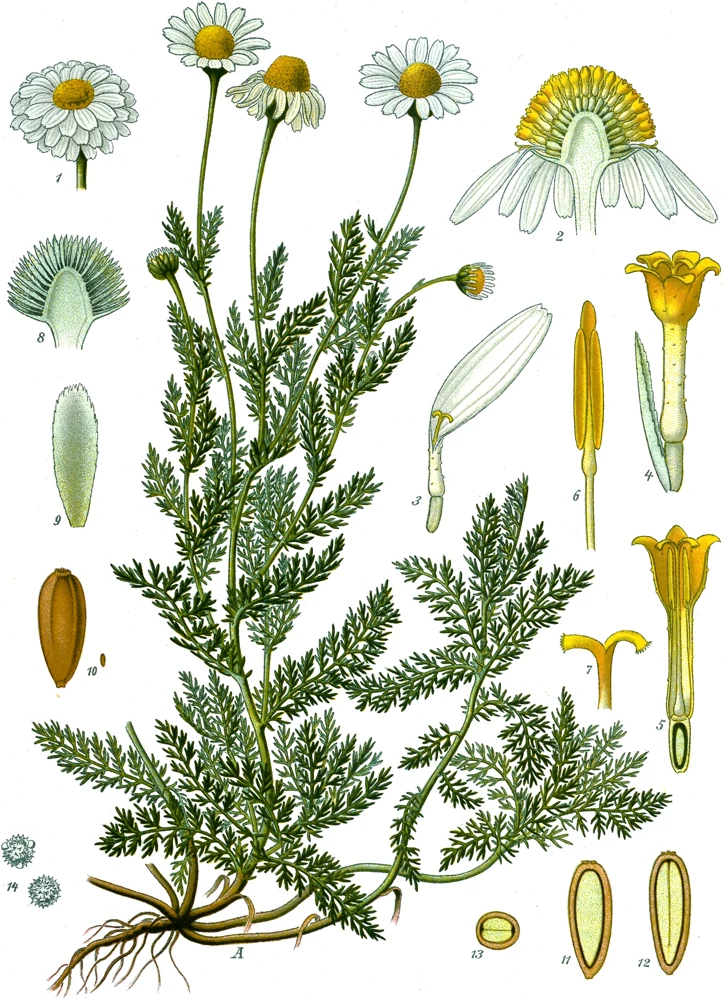
Also known as: Roman chamomile, Anthemis nobilis L.
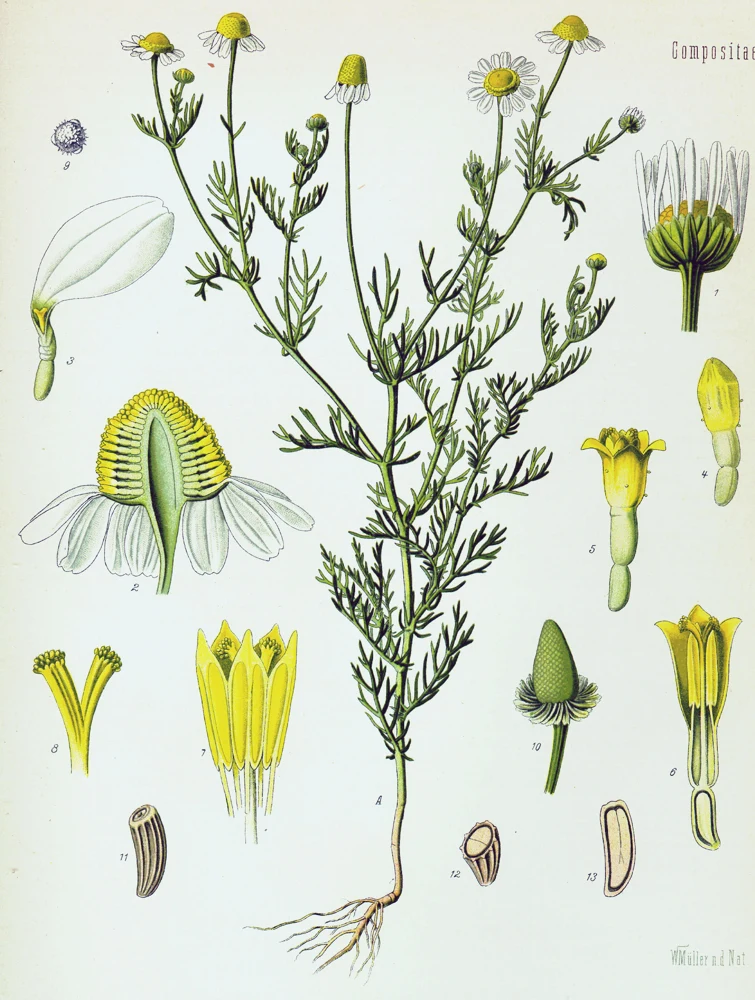
German chamomile is a different species; its indications cannot automatically be transferred.
An illustration is not enough to identify a plant for consumption. Do not forage for a species based solely on this profile.
01 · UNDERSTAND
Properties & uses.
Digestive comfort
Traditional use for mild digestive spasms, bloating and flatulence.
Read the sourceThe traditional uses described are not clinical proof of effectiveness. Evidence for one preparation cannot automatically be applied to another.
02 · UNDERSTAND THE ACTION
How does the plant act?
Roman chamomile is a species distinct from German chamomile. Its flowers are mainly used traditionally for digestive complaints, such as mild spasms, bloating and gas. Experiments on intestinal muscle make this use plausible, without constituting a therapeutic trial in people. Human data on relaxation come notably from aromatic massages: they do not demonstrate the effectiveness of an infusion for anxiety or insomnia.
Constituents to know.
Their presence and quantity depend on the plant part and preparation.
- Esters in the aromatic fraction
- The essential oil of the flowers is rich in esters, including angelates and tiglates. Its composition does not reproduce that of the infusion and differs from the aromatic profile of German chamomile.Read the reference
- Flavonoids and sesquiterpene lactones
- The flowers contain derivatives of apigenin and luteolin, as well as nobilin and related substances. These groups contribute to the plant’s chemical complexity; none alone is sufficient to define its clinical efficacy.Read the reference
Traditional relief of minor digestive problems
The monograph covers mild spasmodic digestive complaints, with distension and flatulence. It is based on long-standing use and does not classify Roman chamomile as a treatment whose efficacy has been established by robust trials.
Read the referenceSmooth muscle relaxation: experimental observations
Extracts and flavonoid-rich fractions relax precontracted intestinal tissues in an organ bath. The crude extract may initially cause a transient contraction. This complex response cannot be reduced to a universal antispasmodic effect.
Read the referenceRelaxation and sleep: uncertain specific benefit
The EMA assessment notes the lack of rigorous clinical research. Results obtained with German chamomile must not be attributed to this species, even though some chemical families are shared.
Read the referenceWhat this means for preparation.
Choose flowers whose label specifies Chamaemelum nobile, and do not use a study of Matricaria recutita as supporting evidence. Fragrance, bitterness and concentration vary with the form. The existence of an essential oil does not justify ingesting it at home.
03 · EXAMINE THE EVIDENCE
What the research shows.
A laboratory or animal result alone does not demonstrate a benefit in humans. Each result must be read alongside the preparation studied and its limitations.
A tissue study, including tissue of human origin
- Type of research
- Experimental study published in 2018 on isolated guinea pig and rat tissues and on human intestinal fragments.
- Preparation concerned
- Hydroethanolic flower extract, fractions, isolated flavonoids and essential oil of Chamaemelum nobile.
- Observed results
- The extract produces an initial contractile response followed by relaxation; relaxation is associated particularly with flavonoid-rich fractions. The oil tested also has a relaxing effect in this experimental system.
- Limitations to consider
- Isolated human tissue is not a treated patient: this experiment does not establish absorption, metabolism, tolerability or symptomatic benefit after ingestion.
Aromatherapy massage in palliative care
- Type of research
- A 1999 trial allocating 103 patients to massage with a carrier oil or massage with added Roman chamomile essential oil.
- Preparation concerned
- External application combined with massage; no herbal tea or oral intake.
- Observed results
- Anxiety decreased after the massages; several quality-of-life and symptom scores improved in the aromatherapy group.
- Limitations to consider
- The effect of massage, the care setting and methodological limitations prevent a reliable anxiolytic effect from being attributed to the plant alone. No results concern ordinary insomnia.
What can we take from this?
The dossier supports an explanation of traditional digestive use and experimental plausibility. It does not provide strong evidence for prescribing this plant for anxiety, insomnia, a digestive disease or a skin condition.
Documentary review dated 09/10/2026. The references remain available to check the context.
04 · CHOOSE A PREPARATION
One plant, several preparations.
Only forms documented in this profile’s sources are presented.
InfusionFlowers · Route: oral
Whole or fragmented dried flowers.
Please note: Ensure the correct botanical identity.
Read the sourceLiquid extractFlowers · Route: oral
Hydroalcoholic extract defined in the monograph.
Please note: Contains alcohol; follow the package leaflet.
Read the source05 · BEFORE ANY USE
Precautions & contraindications.
This guidance does not cover every individual situation. Missing information is not a guarantee of safety.
Contraindications
- Allergy to the plant or to Asteraceae.
Medicine interactions
- No interactions reported in the monograph; this does not guarantee compatibility with all treatments.
Adverse effects
- No adverse effects reported in this monograph; a reaction is still possible.
Pregnancy & breastfeeding
Pregnancy and breastfeeding: medicinal use is not recommended because of insufficient data. Safety has not been established.
Children & adolescents
Under 12 years: not recommended due to lack of data.
If symptoms persist, worsen or are unusual, consult a healthcare professional. In an emergency, contact the emergency services.
06 · PUTTING KNOWLEDGE INTO PRACTICE
Preparations & recipes.
A DOCUMENTED PREPARATION
Roman chamomile infusion — adults
Traditional use for mild digestive spasms, bloating and flatulence. It does not establish clinically proven efficacy.
Plant part: Dried flower heads
Ingredients & quantities
- 1 to 4 g of dried flowers
- 100 to 150 ml of boiling water
Preparation steps
- Check the species and plant part on the packaging; weigh the specified quantity.
- Pour the stated volume of boiling water over the herb in a heatproof cup.
- Steep for 5–15 minutes unless the leaflet says otherwise: the general EMA glossary method; this species monograph gives no specific time.
- Strain and cool to a comfortable drinking temperature.
Use: Monograph: 3 times daily between meals. Seek medical advice after two weeks or if symptoms worsen.
Storage: Prepare immediately before use according to the EMA glossary. No household storage period is documented in the monograph; do not prepare a batch for later use.
Before you start. This guide restricts use to adults aged 18 and over. Do not use with allergy to Roman chamomile or other Asteraceae plants. Do not confuse with German chamomile, whose uses and amounts differ. Pregnancy and breastfeeding: not recommended because safety data are insufficient. Seek advice with adverse reactions.
07 · CHECK THE SOURCES
Sources for this profile.
- EMA — Chamaemelum nobile (L.) All.: overview and documentsAccessed on 08/10/2026
- EMA — monograph on Chamaemelum nobile (L.) All.Accessed on 09/10/2026
- Royal Botanic Gardens, Kew — botanical identityAccessed on 08/10/2026
- EMA — Assessment report on Chamaemelum nobile (L.) All., flosAccessed on 09/10/2026
- Sándor et al. (2018) — Evidence Supports Tradition: The in Vitro Effects of Roman Chamomile on Smooth MusclesAccessed on 09/10/2026
- Wilkinson et al. (1999) — An evaluation of aromatherapy massage in palliative careAccessed on 09/10/2026
- EMA — Glossary on herbal teas: general preparation methodAccessed on 09/10/2026
Illustration: Franz Eugen Köhler, Köhler’s Medizinal-Pflanzen · Public domain (Public Domain Mark 1.0). View the original image and its licence. Image resized and converted to WebP.
A TOUCH OF SOLÉA
Myriam’s tip
Myriam is reviewing the tip for this profile.
Myriam