Identity & origin
BOTANICAL IDENTITY
The right name is the first step.
This profile concerns the root. The uses described depend on the preparation.
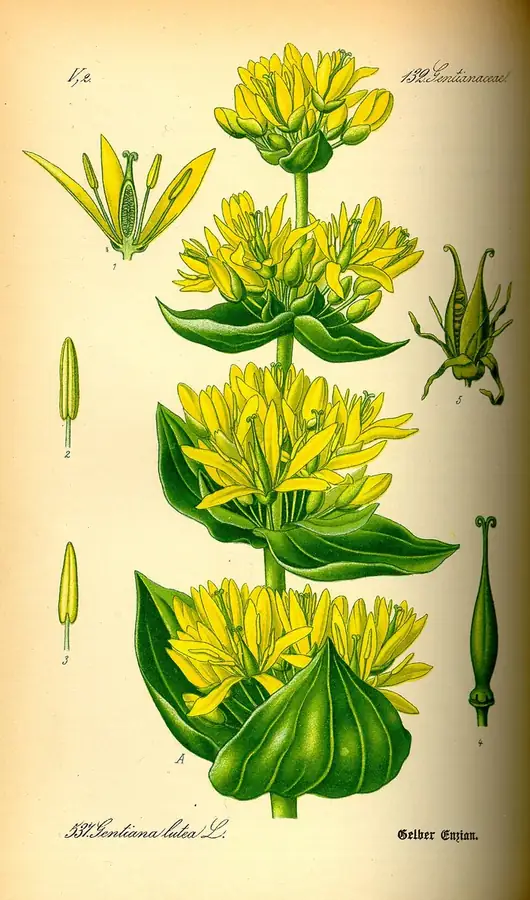
Also known as: Great yellow gentian
Do not forage without expertise: possible confusion with toxic false hellebore.
An illustration is not enough to identify a plant for consumption. Do not forage for a species based solely on this profile.
Uses & evidence
UNDERSTANDING THE USES
Properties & uses.
Appetite and digestion
Traditional use for temporary loss of appetite and mild digestive complaints.
Use considered plausible in a traditional-use monograph. That status alone does not demonstrate clinical efficacy.
Read the sourceThe traditional uses described are not clinical proof of effectiveness. Evidence for one preparation cannot automatically be applied to another.
Precautions before use
BEFORE ANY USE
Precautions & contraindications.
This guidance does not cover every individual situation. Missing information is not a guarantee of safety.
Contraindications & precautions
- Insufficient dataFull documentary reassessment is incomplete: the existing information is not a guarantee of no risk. Ask a pharmacist to check the preparation and medicines.
Medicine interactions
- Insufficient dataFull documentary reassessment is incomplete: the existing information is not a guarantee of no risk. Ask a pharmacist to check the preparation and medicines.
Other retained warnings · review incomplete
These existing warnings remain relevant to consult. Their exhaustive reassessment is outside this targeted review.
Restrictions and precautions
- Allergy to gentian.
Medicine interactions
- No established interaction is included in this entry; this does not guarantee compatibility with a treatment.
Pregnancy, breastfeeding and children
Pregnancy and breastfeeding: medicinal use is not recommended because of insufficient data.
For adults only in this leaflet; insufficient pediatric data.
“Reported” does not prove causality; “possible” may reflect indirect evidence. “None reported” means none in the cited source, not that all combinations have been studied. Do not stop a prescribed treatment based on this profile.
Adverse effects
- Adverse effects insufficiently documented in the sources used here.
Pregnancy & breastfeeding
Food supplements: avoid during pregnancy and breastfeeding because data are insufficient. This is not a conclusion for every medicine.
SourceChildren & adolescents
Food supplements: ANSES advises against use below 18 years; this does not validate a paediatric recipe.
SourceIf symptoms persist, worsen or are unusual, consult a healthcare professional. In an emergency, contact the emergency services.
Forms & how they are used
DOCUMENTED FORMS
One plant, several preparations.
Only forms documented in this profile’s sources are presented.
Herbal teaRoot · Route: oral
Dried, cut root.
Please note: Follow the product's package leaflet; preparations are not interchangeable.
Read the sourceExtractRoot · Route: oral
Documented liquid or dry extracts.
Please note: Alcohol content and concentration vary by product.
Read the sourcePreparations: ingredients & steps
DOCUMENTED PREPARATIONS
Preparations & recipes.
A DOCUMENTED PREPARATION
Yellow gentian infusion — digestive bitters
Traditional reference for mild digestive discomfort and temporary loss of appetite. This infusion has no established clinical benefit and does not treat unexplained appetite loss.
Plant part: Dried cut root
Ingredients & quantities
- 0.6–2 g dried cut root of Gentiana lutea L.
- 150 ml boiling drinking water
Preparation steps
- Check the botanical name and plant part on a quality-controlled herbal tea; weigh the herb.
- Pour 150 ml boiling drinking water over the herb in a heatproof container.
- Steep for 5–15 minutes unless the product leaflet says otherwise. This is the EMA glossary’s general method; the monograph gives no preparation-specific time.
- Strain, then allow to cool to a comfortable temperature before drinking.
Use: EMA reference: one 150 ml preparation, 1–3 times daily; total herb 0.6–6 g/day. For temporary appetite loss, the monograph specifies half an hour before a meal. Seek advice if symptoms persist beyond 2 weeks or worsen.
Storage: Prepare immediately before use, following the EMA glossary. The monograph provides no domestic storage period; do not prepare a stock batch.
Before you start. For adults aged 18+ in this collection. Not recommended during pregnancy or breastfeeding because sufficient safety data are lacking. Contraindicated with gentian allergy. Use under 18 is not established in the monograph. Stop and seek advice if an adverse effect occurs. Use commercially supplied, correctly identified root; a photograph is insufficient for wild collection. No interactions are reported in this monograph; this does not establish compatibility with medicines. Ask a pharmacist if you take medication.
Understanding the plant’s actions
EXPLORE THE EVIDENCE
How does the plant act?
Yellow gentian is among the plants traditionally used for temporary loss of appetite and mild digestive disorders. The root is the part studied. Its reputation should not extend to all gentians: the EMA report selects research relevant to Gentiana lutea and excludes extrapolations from Asian species or isolated molecules. A chemical property therefore does not prove a benefit from all root preparations.
Constituents to know.
Their presence and quantity depend on the plant part and preparation.
- Gentiopicroside
- This secoiridoid is studied in various gentians. Results for the isolated molecule are not sufficient to characterize the efficacy of a G. lutea preparation.Read the reference
Temporary loss of appetite
Traditional recognition concerns a temporary situation; persistent loss of appetite accompanied by weight loss requires investigation of the cause.
Use considered plausible in a traditional-use monograph. That status alone does not demonstrate clinical efficacy.
Read the referenceBloating and difficult digestion
Root preparations have a traditional use for these mild complaints, without evidence of general correction of digestive function.
Use considered plausible in a traditional-use monograph. That status alone does not demonstrate clinical efficacy.
Read the referenceWhat this means for preparation.
Read the full Latin name and the part used. The documented herbal tea and alcoholic extracts must be understood separately; a change of solvent is not simply a change of presentation.
Studies, findings & limitations
THE RESEARCH
What the research shows.
A laboratory or animal result alone does not demonstrate a benefit in humans. Each result must be read alongside the preparation studied and its limitations.
Study selection matters
The references do not establish a benefit. Lack of evidence is not assurance of safety.
- Type of research
- EMA review of the literature on the root.
- Preparation concerned
- Gentiana lutea root and the preparations described, including tinctures.
- Observed results
- Many publications concern other species and especially isolated constituents; they are not automatically relevant to this monograph.
- Limitations to consider
- The number of articles on the genus Gentiana is not a measure of clinical evidence for a yellow gentian herbal tea.
What can we take from this?
The dossier does not support promises of an effect on weight, liver disease or a specific digestive condition. No result from another gentian is attributed here to this species.
Documentary review dated 09/10/2026. The references remain available to check the context.
Sources & last review
CHECKING REFERENCES
Sources for this profile.
- EMA — Gentianae radix: assessment and documentsAccessed on 09/10/2026
- ANSES — synthèse juin2023, compléments alimentairesAccessed on 09/10/2026
- EMA — assessment report on Gentiana lutea, root, revision 1Accessed on 09/10/2026
- EMA — Gentiana lutea L., radix: monograph, preparation and precautionsAccessed on 09/10/2026
- EMA — Glossary on herbal teas: general methods, §4Accessed on 09/10/2026
Image: Flora von Deutschland, Österreich und der Schweiz — Otto Wilhelm Thomé (1885), via Wikimedia Commons · Public domain. View the original image and its licence. Image resized and converted to WebP.