BOTANICAL IDENTITY
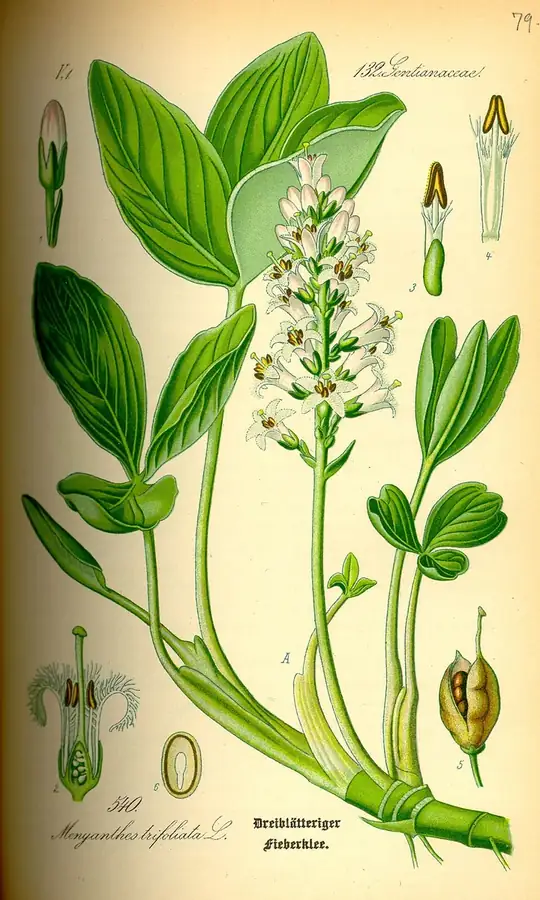
The right name is the first step.
Also known as: buckbean, bogbean
It is not a clover of the genus Trifolium.
An illustration is not enough to identify a plant for consumption. Do not forage for a species based solely on this profile.
01 · UNDERSTAND
Properties & uses.
Digestion and appetite
Traditional use for temporary loss of appetite, bloating and flatulence.
Read the sourceThe traditional uses described are not clinical proof of effectiveness. Evidence for one preparation cannot automatically be applied to another.
02 · UNDERSTAND THE ACTION
How does the plant act?
Bogbean is documented through its leaves. It has two traditional areas of use that must remain separate: digestion and appetite on the one hand, and minor joint or muscle pain on the other. The term “traditional” indicates the basis for these uses, without establishing the potency of an extract or identifying a certain clinical mechanism. The common name does not allow this species to be replaced by another trefoil.
Digestion and appetite
Use concerns temporary loss of appetite, mild bloating or flatulence. It is not enough to explain unintentional weight loss.
Read the referenceMinor pain
The traditional scope includes minor joint and muscle pain, without demonstrating an effect on osteoarthritis progression.
Read the referenceWhat this means for preparation.
Check the name Menyanthes trifoliata, the leaf used and the preparation's precautions.
03 · EXAMINE THE EVIDENCE
What the research shows.
A laboratory or animal result alone does not demonstrate a benefit in humans. Each result must be read alongside the preparation studied and its limitations.
Two uses, a traditional evidence level
- Type of research
- EMA assessment of Menyanthes trifoliata, leaf.
- Preparation concerned
- Leaves in oral aqueous preparations.
- Observed results
- The selected indications are based on sufficiently documented long-standing use.
- Limitations to consider
- The dossier does not allow a clinical benefit to be quantified here or the plant to be compared with an anti-inflammatory medicine.
What can we take from this?
No specific constituent or mechanism is inferred from bitterness alone. This profile does not propose a hormonal, general antirheumatic or depurative action.
Documentary review dated 09/10/2026. The references remain available to check the context.
04 · CHOOSE A PREPARATION
One plant, several preparations.
Only forms documented in this profile’s sources are presented.
Infusion or decoctionLeaves · Route: oral
Fragmented leaves; prepare according to the documented product.
Please note: Follow the product's package leaflet; preparations are not interchangeable.
Read the source05 · BEFORE ANY USE
Precautions & contraindications.
This guidance does not cover every individual situation. Missing information is not a guarantee of safety.
Contraindications
- Allergy to the plant.
Medicine interactions
- No established interaction is included in this entry; this does not guarantee compatibility with a treatment.
Adverse effects
- Adverse effects insufficiently documented in the sources used here.
Pregnancy & breastfeeding
Pregnancy and breastfeeding: medicinal use is not recommended because of insufficient data.
Children & adolescents
For adults only in this leaflet; insufficient pediatric data.
If symptoms persist, worsen or are unusual, consult a healthcare professional. In an emergency, contact the emergency services.
06 · PUTTING KNOWLEDGE INTO PRACTICE
Preparations & recipes.
No home recipe is provided in this profile. For an appropriate preparation, refer to the product leaflet and ask your pharmacist for advice.
07 · CHECK THE SOURCES
Sources for this profile.
- EMA — Menyanthidis trifoliatae folium: assessment and documentsAccessed on 09/10/2026
- EMA — reference document consultedAccessed on 09/10/2026
Illustration: Flora von Deutschland, Österreich und der Schweiz — Otto Wilhelm Thomé (1885), via Wikimedia Commons · Public domain. View the original image and its licence. Image resized and converted to WebP.
A TOUCH OF SOLÉA
Myriam’s tip
Myriam is reviewing the tip for this profile.
Myriam