Identity & origin
BOTANICAL IDENTITY
The right name is the first step.
This entry concerns leaves. The uses described depend on the preparation.
Also known as: No synonyms listed.
Check the scientific name and the part used; a photograph is not sufficient for foraging plants intended for consumption.
An illustration is not enough to identify a plant for consumption. Do not forage for a species based solely on this profile.
Uses & evidence
UNDERSTANDING THE USES
Properties & uses.
Productive cough
Well-established use of certain extracts to facilitate expectoration.
EMA status applies only to the described preparation and indication, not every form of the plant.
Read the sourceThe traditional uses described are not clinical proof of effectiveness. Evidence for one preparation cannot automatically be applied to another.
Precautions before use
BEFORE ANY USE
Precautions & contraindications.
This guidance does not cover every individual situation. Missing information is not a guarantee of safety.
Contraindications & precautions
- Source-listed contraindicationIvy/Araliaceae allergy; medicinal preparations are contraindicated below age 2 because respiratory symptoms may worsen.Source
Medicine interactions
- Insufficient dataFull documentary reassessment is incomplete: the existing information is not a guarantee of no risk. Ask a pharmacist to check the preparation and medicines.
Other retained warnings · review incomplete
These existing warnings remain relevant to consult. Their exhaustive reassessment is outside this targeted review.
Restrictions and precautions
- Allergy to ivy or Araliaceae.
- Contraindicated under 2 years; caution in gastritis or ulcers.
Medicine interactions
- No established interaction is included in this entry; this does not guarantee compatibility with a treatment.
Pregnancy, breastfeeding and children
Pregnancy and breastfeeding: medicinal use is not recommended because of insufficient data.
Prohibited under 2 years. From 2 to 4 years, persistent or recurrent cough: medical diagnosis before treatment.
“Reported” does not prove causality; “possible” may reflect indirect evidence. “None reported” means none in the cited source, not that all combinations have been studied. Do not stop a prescribed treatment based on this profile.
Adverse effects
- Nausea, vomiting, diarrhea; allergies sometimes accompanied by breathing difficulties.
Pregnancy & breastfeeding
Supplements: avoid during pregnancy/breastfeeding because data are lacking (ANSES). The full medicinal PDF remains to be reread.
SourceChildren & adolescents
Medicines: only from age 2 according to the preparation; contraindicated below that age. The summary does not authorise tea made from gathered leaves.
SourceIf symptoms persist, worsen or are unusual, consult a healthcare professional. In an emergency, contact the emergency services.
Forms & how they are used
DOCUMENTED FORMS
One plant, several preparations.
Only forms documented in this profile’s sources are presented.
Dry extractLeaves · Route: oral
Medicine with a defined extract.
Please note: Follow the product's package leaflet; preparations are not interchangeable.
Read the sourceLiquid or soft extractLeaves · Route: oral
Controlled pharmaceutical preparation.
Please note: Never make herbal tea or recipes from picked leaves.
Read the sourceUnderstanding the plant’s actions
EXPLORE THE EVIDENCE
How does the plant act?
Ivy is a case where well-defined leaf extracts have well-established medicinal use as expectorants for a productive cough. This assessment does not concern an infusion of gathered leaves. Research on saponins explores bronchial receptor regulation and smooth muscle relaxation; it sheds light on a possible mechanism without turning ivy into a rescue medicine for an asthma attack.
Constituents to know.
Their presence and quantity depend on the plant part and preparation.
- Saponins: α-hederin and hederacoside C
- These related substances do not necessarily have the same activity; experiments on receptor regulation distinguish their effects.Read the reference
Facilitating expectoration
The pharmaceutical extracts included are used to help clear secretions in a productive cough. Extraction quality is part of the assessment.
EMA status applies only to the described preparation and indication, not every form of the plant.
Read the referenceRegulation of β₂ receptors
In cell culture, α-hederin limited β₂ receptor internalization after stimulation. This is not demonstrated direct binding such as that of a bronchial agonist.
Laboratory or animal observation. A human benefit cannot be inferred from this finding alone.
Read the referenceWhat this means for preparation.
Choose only a medicine with a controlled extract, suitable for the person's age. Raw leaves and berries are not ingredients for a home recipe.
Studies, findings & limitations
THE RESEARCH
What the research shows.
A laboratory or animal result alone does not demonstrate a benefit in humans. Each result must be read alongside the preparation studied and its limitations.
A detailed cellular hypothesis
Laboratory or animal observation. A human benefit cannot be inferred from this finding alone.
- Type of research
- In vitro experiments on alveolar epithelial cells and muscle cells, summarized by the EMA.
- Preparation concerned
- Isolated α-hederin, compared with related saponins.
- Observed results
- Changes in receptor regulation and intracellular signaling were observed; not all tested compounds shared these effects.
- Limitations to consider
- Isolated molecule and experimental conditions: this observation is not a direct measure of cough relief in a patient.
What can we take from this?
Expectorant activity does not mean treatment of pneumonia or asthma. In very young children, secretions and coughing can become problematic: the restriction under two years is essential.
Documentary review dated 09/10/2026. The references remain available to check the context.
Sources & last review
CHECKING REFERENCES
Sources for this profile.
- EMA — document officiel partiellement relu, lierre-grimpantAccessed on 09/10/2026
- ANSES — synthèse juin2023, compléments alimentairesAccessed on 09/10/2026
- EMA — Assessment report on Hedera helix, leaf, revision 2Accessed on 09/10/2026
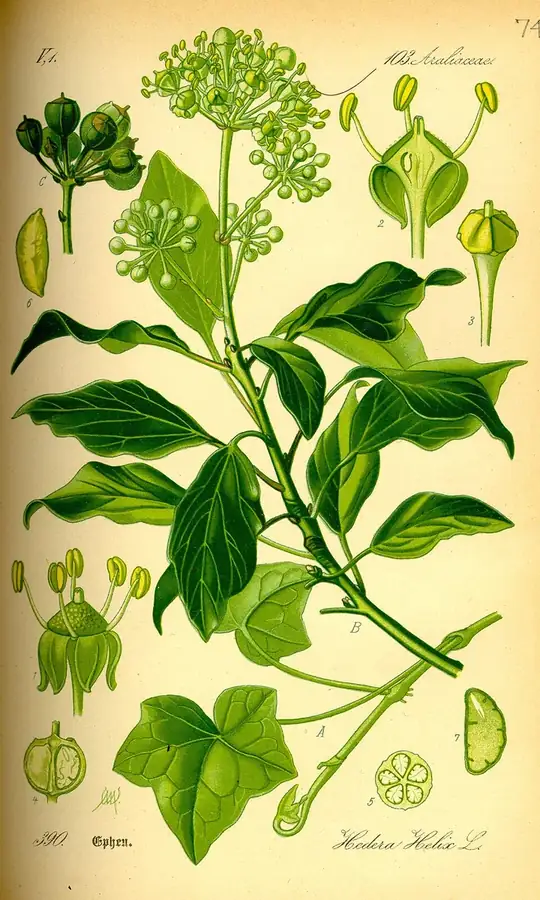
Image: Flora von Deutschland, Österreich und der Schweiz — Otto Wilhelm Thomé (1885), via Wikimedia Commons · Public domain. View the original image and its licence. Image resized and converted to WebP.