BOTANICAL IDENTITY
The right name is the first step.
Also known as: No synonyms listed.
Check the scientific name and the part used; a photograph is not sufficient for foraging plants intended for consumption.
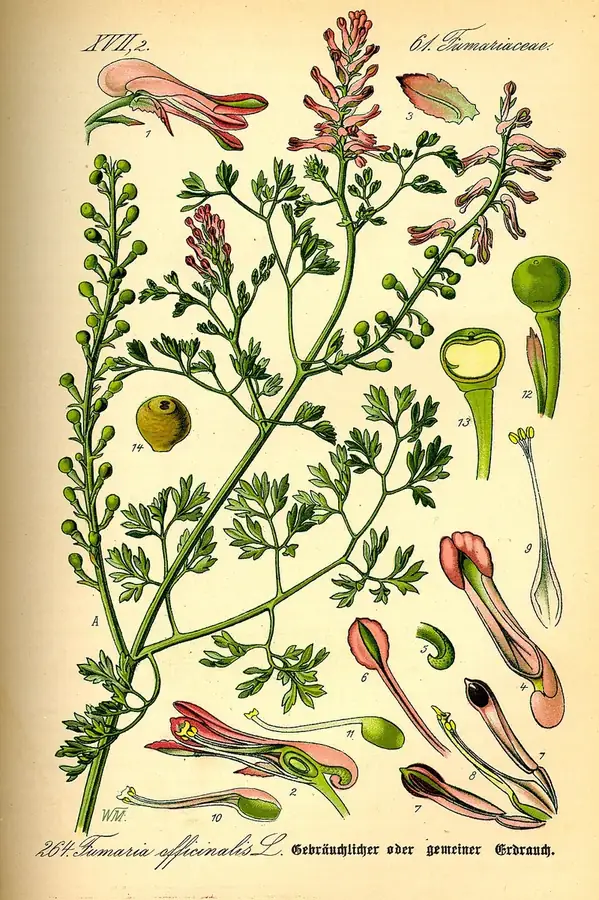
An illustration is not enough to identify a plant for consumption. Do not forage for a species based solely on this profile.
01 · UNDERSTAND
Properties & uses.
Digestive comfort
Traditional use for heaviness after meals, slow digestion and flatulence.
Read the sourceThe traditional uses described are not clinical proof of effectiveness. Evidence for one preparation cannot automatically be applied to another.
02 · UNDERSTAND THE ACTION
How does the plant act?
Fumitory is recognized for digestive discomfort described as heaviness, flatulence or slow digestion. Its connection with bile rests mainly on experimental work and the history of its uses. Describing it as a plant that “regulates the liver” would be excessive: the EMA report lacks rigorous clinical research to demonstrate this effect, and biliary disorders are precisely a safety limitation.
Constituents to know.
Their presence and quantity depend on the plant part and preparation.
- Alkaloids, including protopine
- Protopine is characteristic of the plant; a contractile effect on the sphincter of Oddi has been reported in animals, without establishing the action of the whole product in humans.Read the reference
Discomfort after meals
Traditional use is for symptom relief and limited to mild digestive discomfort; it is not an indication for treating liver disease.
Read the referenceBiliary hypothesis
Experimental effects on the biliary system are considered consistent with tradition, but their evidential value remains insufficient to explain human efficacy precisely.
Read the referenceWhat this means for preparation.
A herbal tea, a powder and an extract do not have the same criteria for use, particularly regarding age and concentration. Check the exact form and restrictions concerning the liver, gallstones or bile duct obstruction.
03 · EXAMINE THE EVIDENCE
What the research shows.
A laboratory or animal result alone does not demonstrate a benefit in humans. Each result must be read alongside the preparation studied and its limitations.
Why the evidence level remains traditional
- Type of research
- EMA assessment report, revision 1.
- Preparation concerned
- Aerial parts and preparations of Fumaria officinalis defined in the dossier.
- Observed results
- EMA emphasizes the lack of clinical research and the need for rigorous randomized trials.
- Limitations to consider
- Earlier observations do not replace a reliable comparison; the preparation's pharmacokinetics are not established.
What can we take from this?
No “detoxification” or stone-dissolving effect is established. A potential experimental effect on bile does not make self-treatment of biliary pain advisable.
Documentary review dated 09/10/2026. The references remain available to check the context.
04 · CHOOSE A PREPARATION
One plant, several preparations.
Only forms documented in this profile’s sources are presented.
InfusionFlowering aerial parts · Route: oral
Cut flowering parts.
Please note: Follow the product's package leaflet; preparations are not interchangeable.
Read the sourcePowder or extractFlowering aerial parts · Route: oral
Powder, aqueous or hydroalcoholic extracts documented.
Please note: Different concentrations; also check the product's alcohol content.
Read the source05 · BEFORE ANY USE
Precautions & contraindications.
This guidance does not cover every individual situation. Missing information is not a guarantee of safety.
Contraindications
- Allergy to fumitory.
- Not recommended in biliary obstruction, cholangitis, gallstones or liver disease.
Medicine interactions
- No interaction reported in the monograph; absence of a signal ≠ absence of risk.
Adverse effects
- No known adverse effects in the monograph.
Pregnancy & breastfeeding
Pregnancy and breastfeeding: medicinal use is not recommended because of insufficient data.
Children & adolescents
Infusion: not recommended under 12. Powder, extracts, tincture and juice: not recommended under 18.
If symptoms persist, worsen or are unusual, consult a healthcare professional. In an emergency, contact the emergency services.
06 · PUTTING KNOWLEDGE INTO PRACTICE
Preparations & recipes.
No home recipe is provided in this profile. For an appropriate preparation, refer to the product leaflet and ask your pharmacist for advice.
07 · CHECK THE SOURCES
Sources for this profile.
- EMA — Fumariae herba: assessment and documentsAccessed on 09/10/2026
- EMA — monograph or final opinion consultedAccessed on 09/10/2026
- ANSES — summary of precautions for food supplements (June 2023)Accessed on 09/10/2026
- EMA — assessment report on Fumaria officinalis, revision 1Accessed on 09/10/2026
Illustration: Flora von Deutschland, Österreich und der Schweiz — Otto Wilhelm Thomé (1885), via Wikimedia Commons · Public domain. View the original image and its licence. Image resized and converted to WebP.
A TOUCH OF SOLÉA
Myriam’s tip
Myriam is reviewing the tip for this profile.
Myriam