
Identity & origin
BOTANICAL IDENTITY
The right name is the first step.
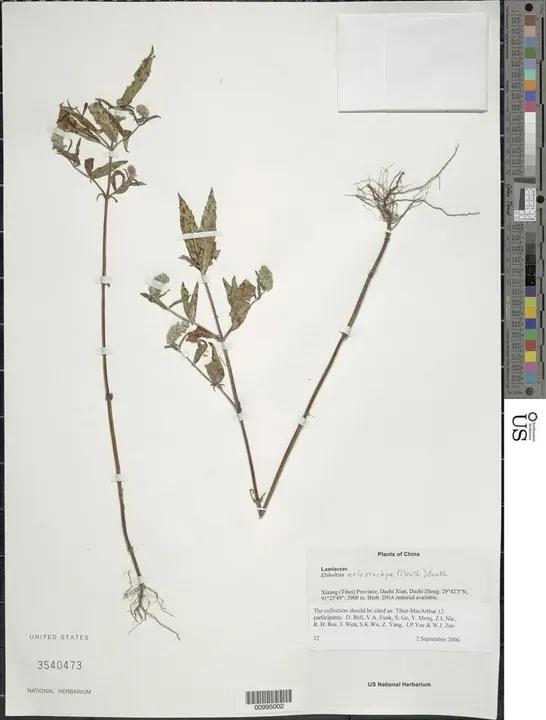
Elsholtzia eriostachya belongs to Lamiaceae. Kew describes it as follows: it is an annual and grows primarily in the temperate biome. POWO accepts Elsholtzia eriostachya (Benth.) Benth.; the article’s name is standardised against that reference. The Dagala inventory gives the transliterated name “byi-ru-ser-po”. This profile documents identity and medical tradition; it is not a therapeutic monograph.
Also known as: byi-ru-ser-po
Identify Elsholtzia eriostachya (Benth.) Benth. precisely. A shared traditional name or membership of Elsholtzia does not justify transferring uses. Plant-part wording follows the table without anatomical reinterpretation.
An illustration is not enough to identify a plant for consumption. Do not forage for a species based solely on this profile.
Uses & evidence
UNDERSTANDING THE USES
Properties & uses.
Indications recorded in Bhutanese materia medica
Table 1 of the 2016 Dagala study associates whole plant with wounds, skin conditions, disorders termed phlegm disorders and a traditional antibacterial role. These are traditional indications transcribed from texts and references for the g.so-ba-rig-pa system. The botanical record at Tshotshom is not an observation of recovery: this entry establishes neither causation nor clinical efficacy. The row does not specify a route or a species-specific preparation.
Use reported in a survey or inventory. This establishes neither benefit nor safety.
Read the sourceThe traditional uses described are not clinical proof of effectiveness. Evidence for one preparation cannot automatically be applied to another.
Precautions before use
BEFORE ANY USE
Precautions & contraindications.
This guidance does not cover every individual situation. Missing information is not a guarantee of safety.
The following warnings do not constitute a complete review of interactions or contraindications. An unstudied combination cannot be considered compatible.
Contraindications & precautions
- The cited sources do not establish a contraindication assessment for this species. Consult a healthcare professional before any medicinal use.
Medicine interactions
- Medicine combinations were not evaluated in this inventory. Ask a pharmacist or prescriber to review any intended medicinal use.
“Reported” does not prove causality; “possible” may reflect indirect evidence. “None reported” means none in the cited source, not that all combinations have been studied. Do not stop a prescribed treatment based on this profile.
Adverse effects
- The study provides neither adverse-event monitoring nor event frequencies. Lack of measurement does not establish safety.
Pregnancy & breastfeeding
Pregnancy and breastfeeding: the selected sources provide no usable safety assessment; avoid self-medication with this plant.
Children & adolescents
Do not use this plant medicinally in children without professional direction. The inventory does not validate paediatric safety or an appropriate preparation.
If symptoms persist, worsen or are unusual, consult a healthcare professional. In an emergency, contact the emergency services.
Available evidence
EXPLORE THE EVIDENCE
The available evidence.
The 2016 inventory links the traditional name, part and altitude for Elsholtzia eriostachya. Fieldwork supports identification; medical texts supply the indications. Local inhabitants were not interviewed about treatments and no patients were followed.
Reported use, without an effect demonstrated by this inventory
For Elsholtzia eriostachya, the part “whole plant” appears in this medical repertoire. This traditional attribution establishes neither a pharmacological mechanism nor efficacy.
Use reported in a survey or inventory. This establishes neither benefit nor safety.
Read the referenceLimitations to keep in mind.
Antibacterial appears in a column of traditional indications; the row identifies no organism, laboratory assay or clinical result.
Studies, findings & limitations
THE RESEARCH
What the research shows.
A laboratory or animal result alone does not demonstrate a benefit in humans. Each result must be read alongside the preparation studied and its limitations.
Dagala inventory: identity, location and resource status
Use reported in a survey or inventory. This establishes neither benefit nor safety.
- Type of research
- Field observations, photographs and herbarium specimens; identification cross-checked against Flora of Bhutan and botanical databases. Convenience sampling, without a comparison group or clinical outcome.
- Preparation concerned
- Recorded part: whole plant. The table gives no reproducible preparation specific to this species.
- Observed results
- At Tshotshom, 4100 m, the plant was classified as rare or infrequently observed in the surveyed sites and listed among species used by Menjong Sorig Pharmaceuticals at the time of the study. These findings describe resources and institutional practice in 2016.
- Limitations to consider
- Local abundance is not a global conservation assessment or a current measurement. The study cannot compare treatments or measure benefits and risks.
What can we take from this?
This documentary review is not exhaustive. The selected sources trace use without establishing a dose, duration or medical indication.
Documentary review dated 09/10/2026. The references remain available to check the context.
Sources & last review
CHECKING REFERENCES
Sources for this profile.
- Royal Botanic Gardens, Kew — Plants of the World Online: Elsholtzia eriostachya (Benth.) Benth.Accessed on 09/10/2026
- Wangchuk et al. (2016) — Medicinal plants of Dagala region in Bhutan: their diversity, distribution, uses and economic potential — Table 1Accessed on 09/10/2026
Image: Smithsonian Institution, NMNH, Botany · CC0 1.0. View the original image and its licence. Image resized and converted to WebP.