Identity & origin
BOTANICAL IDENTITY
The right name is the first step.
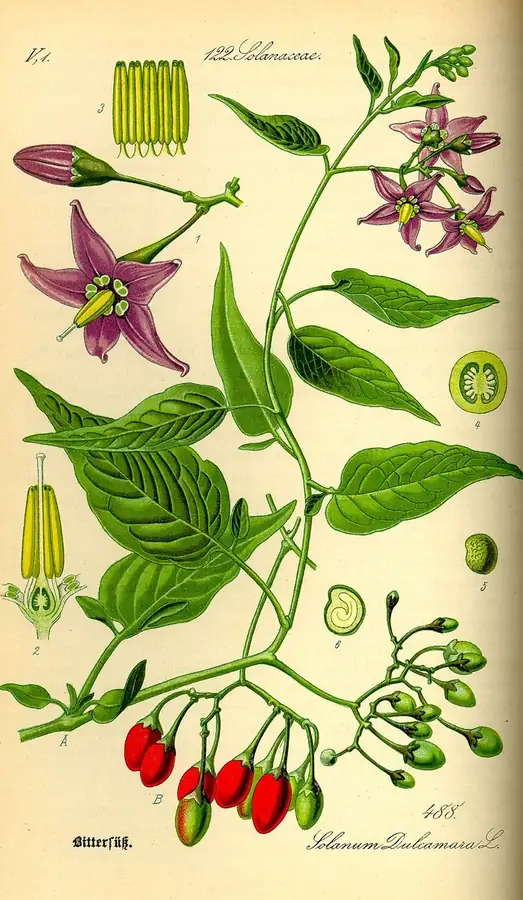
Bittersweet: information on the stem, with uses and precautions specific to documented preparations.
Also known as: No synonyms listed.
The botanical name and part used must match the profile; a photograph alone is not sufficient grounds for consuming a plant.
An illustration is not enough to identify a plant for consumption. Do not forage for a species based solely on this profile.
Uses & evidence
UNDERSTANDING THE USES
Properties & uses.
Mild recurrent eczema
Traditional external use of older stems in a defined preparation. This information does not justify any ingestion.
Use considered plausible in a traditional-use monograph. That status alone does not demonstrate clinical efficacy.
Read the sourceThe traditional uses described are not clinical proof of effectiveness. Evidence for one preparation cannot automatically be applied to another.
Precautions before use
BEFORE ANY USE
Precautions & contraindications.
This guidance does not cover every individual situation. Missing information is not a guarantee of safety.
Contraindications & precautions
- Source-listed contraindicationKnown allergy to the preparation.Source
- PrecautionStrictly external use of specified stems; ingestion or replacement with leaves/fruits is not covered.Source
Medicine interactions
- No interaction reported in the sourceNo interactions reported in the monograph for these preparations; compatibility with every medicine is not established.Source
“Reported” does not prove causality; “possible” may reflect indirect evidence. “None reported” means none in the cited source, not that all combinations have been studied. Do not stop a prescribed treatment based on this profile.
Adverse effects
- The risks require professional checking; no recipe proposed.
Pregnancy & breastfeeding
Not recommended during pregnancy or breastfeeding: insufficient safety data.
SourceChildren & adolescents
Not recommended below 18 because evidence is insufficient.
SourceIf symptoms persist, worsen or are unusual, consult a healthcare professional. In an emergency, contact the emergency services.
Understanding the plant’s actions
EXPLORE THE EVIDENCE
How does the plant act?
Bittersweet is a toxic plant whose medicinal dossier is narrowly limited to topical use of prepared stems. Oral uses are not recognized by the EMA. Its traditional interest for mild recurrent eczema justifies neither harvesting it for ingestion nor improvised application of berries or leaves. Here, safety depends as much on the route of exposure as on composition.
Constituents to know.
Their presence and quantity depend on the plant part and preparation.
- Steroidal glycoalkaloids
- Constituents underlying the main toxicological concerns; their presence precludes equating biological activity with a usable benefit.Read the reference
Limited traditional external use
The assessment concerns symptomatic relief of mild recurrent eczema with the defined stem preparations.
Use considered plausible in a traditional-use monograph. That status alone does not demonstrate clinical efficacy.
Read the referenceWhat this means for preparation.
This profile helps explain a medicinal material, not prepare a home remedy. Never replace stems with berries; a professional must check the product and the suitability of external use.
Studies, findings & limitations
THE RESEARCH
What the research shows.
A laboratory or animal result alone does not demonstrate a benefit in humans. Each result must be read alongside the preparation studied and its limitations.
Why oral use is excluded
The references do not establish a benefit. Lack of evidence is not assurance of safety.
- Type of research
- EMA toxicological and documentary assessment.
- Preparation concerned
- Solanum dulcamara stems and preparations intended for the skin.
- Observed results
- Systemic exposure is expected to be lower through the skin than through ingestion; this contributed to the external-use framework.
- Limitations to consider
- Oral safety documentation is insufficient and glycoalkaloids are toxic. Animal reproduction data reinforce caution during pregnancy and breastfeeding.
What can we take from this?
A substance’s toxicity does not demonstrate an ability to treat cancer or infection. The absence of a recipe is intentional given the risk and available data.
Documentary review dated 09/10/2026. The references remain available to check the context.
Sources & last review
CHECKING REFERENCES
Sources for this profile.
- EMA — Solani dulcamarae stipites: dossier and documentsAccessed on 09/10/2026
- EMA — monograph: Solani dulcamarae stipitesAccessed on 09/10/2026
- EMA — scientific assessment report: Solanum dulcamaraAccessed on 09/10/2026
Image: Kurt Stüber · Public domain. View the original image and its licence. Image resized and converted to WebP.