BOTANICAL IDENTITY
The right name is the first step.
Also known as: pot marigold, pot marigold
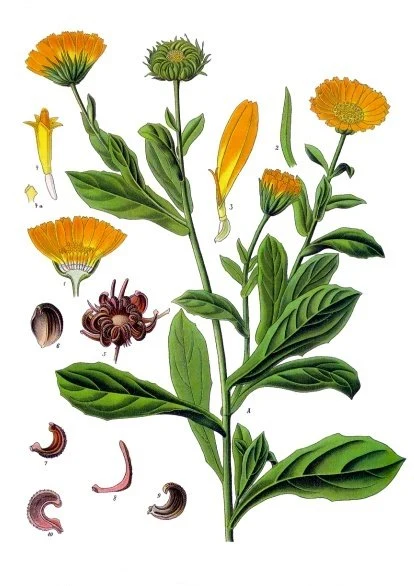
Check for Calendula officinalis. A common name or photograph does not verify a harvested plant.
An illustration is not enough to identify a plant for consumption. Do not forage for a species based solely on this profile.
01 · UNDERSTAND
Properties & uses.
Minor skin irritations
Traditional use for minor skin inflammation and to support the healing of small wounds.
Read the sourceOral comfort
Traditional use of oromucosal preparations for minor inflammation of the mouth or throat.
Read the sourceThe traditional uses described are not clinical proof of effectiveness. Evidence for one preparation cannot automatically be applied to another.
02 · UNDERSTAND THE ACTION
How does the plant act?
Calendula is mainly documented for local applications: minor inflammatory skin conditions, minor wounds and mouth irritations. The flowers provide several families of compounds; the vehicle in a cream or ointment also contributes to the outcome. Experiments on skin repair offer biological leads, but human trials are uneven. In particular, available studies on preventing skin reactions to radiotherapy do not give consistent results.
Constituents to know.
Their presence and quantity depend on the plant part and preparation.
- Triterpenoids, including faradiol derivatives
- These flower constituents have been studied for effects on inflammation in experimental models. Their presence in a product does not allow clinical activity of the same magnitude to be inferred.Read the reference
- Flavonoids and phenolic compounds
- They contribute to the flowers' chemical profile. Aqueous preparations, hydroalcoholic preparations and forms incorporated into a fatty base do not contain exactly the same proportions of substances.Read the reference
Skin soothing and small wounds
Traditional use concerns mild skin inflammation and helping small wounds heal. It does not cover deep, infected or poorly healing wounds.
Read the referenceMinor mouth irritation
Some preparations are intended for oromucosal use for minor inflammation of the mouth or throat. This local route differs from a herbal tea taken for a systemic effect.
Read the referenceTissue repair: cells and animals
Extracts promote the migration or proliferation of fibroblasts in culture and modify wound repair in animals. The preparations and models differ from human skin in real-life conditions; this represents biological plausibility.
Read the referenceWhat this means for preparation.
For local application, identify the complete product, its route of use and its excipients. During radiotherapy, any cream should be chosen with the healthcare team. One calendula preparation is not interchangeable with another, and allergy to Asteraceae remains relevant even with external use.
03 · EXAMINE THE EVIDENCE
What the research shows.
A laboratory or animal result alone does not demonstrate a benefit in humans. Each result must be read alongside the preparation studied and its limitations.
Radiation dermatitis: a favourable signal in 2004
- Type of research
- Randomized trial in 254 women receiving radiotherapy after breast surgery.
- Preparation concerned
- Specific calendula ointment compared with trolamine.
- Observed results
- Dermatitis of at least grade 2 was observed in 41% of participants using calendula, compared with 63% using trolamine. Applying the ointment was considered less easy.
- Limitations to consider
- The comparator and formulation are crucial. A positive result against trolamine does not demonstrate that all calendula products are superior or suitable for every oncology protocol.
2013 trial: no difference compared with an aqueous cream
- Type of research
- Randomized trial with blinded assessment; 420 women allocated, 411 analyzed.
- Preparation concerned
- Calendula cream compared with an Essex aqueous cream during breast radiotherapy.
- Observed results
- No significant difference was observed in severe skin reactions or symptoms reported by the participants.
- Limitations to consider
- The comparison differs from that in 2004. The conflicting results prevent calendula from being presented as consistently effective in preventing radiation-induced lesions.
2021 trial: persistent uncertainty
- Type of research
- Randomized trial with 82 participants, 81 included in the analysis; recruitment remained below the planned target.
- Preparation concerned
- Topical calendula preparation compared with a Sorbolene cream.
- Observed results
- The study found no statistically significant difference in radiotherapy-related dermatitis between the groups.
- Limitations to consider
- Insufficient statistical power limits interpretation of a negative result. Taken together with the other trials, it reinforces uncertainty rather than supporting a conclusion of assured efficacy or definitive ineffectiveness.
What can we take from this?
Wound healing involves many mechanisms and depends on the type of lesion. Experimental data and a single favourable trial are insufficient to recommend this plant for chronic ulcers, infections or radiotherapy lesions.
Documentary review dated 09/10/2026. The references remain available to check the context.
04 · CHOOSE A PREPARATION
One plant, several preparations.
Only forms documented in this profile’s sources are presented.
Infusion for external useFlowers · Route: topical
Preparation of compresses according to the monograph.
Please note: Seek medical advice if there are signs of infection.
Read the sourceMouthwashFlowers · Route: mouth
Infusion or preparation suitable for use as a mouth rinse.
Please note: This is not a herbal tea for drinking.
Read the sourceOil macerate and balmFlowers · Route: topical
Extracts in a vegetable oil or fatty base, incorporated into defined preparations.
Please note: Follow the product leaflet; concentrations differ.
Read the source05 · BEFORE ANY USE
Precautions & contraindications.
This guidance does not cover every individual situation. Missing information is not a guarantee of safety.
Contraindications
- Allergy to calendula or Asteraceae.
Medicine interactions
- No interactions reported in the monograph; this does not guarantee compatibility with all treatments.
Adverse effects
- Skin sensitisation reported; frequency unknown.
Pregnancy & breastfeeding
Pregnancy and breastfeeding: medicinal use is not recommended because of insufficient data. Safety has not been established.
Children & adolescents
Skin: not recommended under 6 years. Mouth/throat: not recommended under 12 years due to insufficient data.
If symptoms persist, worsen or are unusual, consult a healthcare professional. In an emergency, contact the emergency services.
06 · PUTTING KNOWLEDGE INTO PRACTICE
Preparations & recipes.
A DOCUMENTED PREPARATION
Lukewarm calendula compress
Traditional use for minor skin inflammation. This non-sterile preparation is restricted here to intact skin.
Plant part: Dried flowers
Ingredients & quantities
- 1–2 g quality-controlled dried Calendula officinalis L. flowers
- 150 ml boiling drinking water
- A clean single-use compress
Preparation steps
- Pour the 150 ml boiling water over the weighed flowers.
- Steep for 5–15 minutes: the EMA glossary’s general method, as the monograph gives no plant-specific time. Follow the tea’s leaflet first.
- Strain, then allow to cool to a comfortable temperature before use.
- Soak the compress, then apply to the small affected area, avoiding the eyes.
- Remove after 30–60 minutes, as specified by the monograph.
Use: Adults aged 18+. EMA reference: 2–4 applications daily. Seek advice if discomfort lasts over one week, worsens or shows signs of infection.
Storage: Prepare immediately before use (EMA glossary). The monograph establishes no storage period; do not prepare a stock batch.
Before you start. Contraindicated with calendula or Asteraceae allergy. Skin sensitisation is possible. Do not use on a deep or infected wound or a significant burn. Medicinal use is not recommended in pregnancy or breastfeeding because data are insufficient. Ask a professional about appropriate care for broken skin.
A DOCUMENTED PREPARATION
Calendula mouth rinse
Traditional use for minor oral inflammation, with limited clinical evidence. Does not replace dental care.
Plant part: Dried flowers
Ingredients & quantities
- 1–2 g quality-controlled dried Calendula officinalis L. flowers
- 150 ml boiling drinking water
Preparation steps
- Pour the 150 ml boiling water over the weighed flowers.
- Steep for 5–15 minutes: the EMA glossary’s general method, as the monograph gives no plant-specific time. Follow the tea’s leaflet first.
- Strain, then allow to cool to a comfortable temperature before use.
- Rinse the mouth, then spit out the preparation.
Use: Adults aged 18+. EMA reference: 2–4 rinses daily. No exact contact time is defined. Seek advice if symptoms worsen or last over one week.
Storage: Prepare immediately before use (EMA glossary). The monograph establishes no storage period; do not prepare a stock batch.
Before you start. Do not swallow or use in the eyes. Contraindicated with Asteraceae allergy. Stop if an allergic reaction occurs. Medicinal use during pregnancy or breastfeeding is not recommended because data are insufficient. Toothache, swelling or fever require professional advice.
A DOCUMENTED PREPARATION
Calendula — skin compress, ages 6–12
Traditional use for a small area of mildly irritated skin. This paediatric chapter restricts application to intact skin; a wound, blistering burn or infection needs appropriate care.
EMA/HMPC/437450/2017, section 4.2: cutaneous preparation in children; not recommended under 6. This chapter covers ages 6–12, for skin use only.
Read the complete children’s chapterPlant part: Dried flowers
Ingredients & quantities
- 1–2 g dried Calendula officinalis L. flowers
- 150 ml boiling drinking water
- One clean single-use dressing
Preparation steps
- An adult checks the botanical name, plant part and leaflet of a pharmaceutical-quality product, then weighs the amount agreed with the professional.
- Pour boiling water over the herb in a heatproof cup, out of the child’s reach.
- Steep for 5–15 minutes unless the leaflet specifies otherwise: this is the EMA glossary’s general method, not a species-specific time.
- Strain carefully. Allow to cool and check the temperature. Soak a clean dressing, then apply to the small area of intact skin.
Use: EMA reference: 2–4 applications daily; remove the dressing after 30–60 minutes. Do not extend contact time or leave it on during sleep. Consult if symptoms exceed one week, worsen or suggest infection.
Storage: Prepare immediately before use. This source establishes no household shelf life; discard any remainder and do not prepare a stock batch.
Before you start. Before medicinal use in a child, ask a pharmacist or doctor to confirm the product and dose. Do not use with calendula or Asteraceae allergy. Skin sensitisation can occur: stop if a reaction develops. External use only, away from eyes and mucous membranes. The preparation is not sterile and does not replace wound cleaning and care. Mouthwash preparations have a different age threshold.
07 · CHECK THE SOURCES
Sources for this profile.
- EMA — Calendula officinalis L.: summary and documentsAccessed on 08/10/2026
- EMA — Calendula — skin compress, ages 6–12: paediatric sourceAccessed on 09/10/2026
- Royal Botanic Gardens, Kew — botanical identityAccessed on 08/10/2026
- EMA — Assessment report on Calendula officinalis L., flos, Revision 1Accessed on 09/10/2026
- Pommier et al. (2004) — Phase III randomized trial of Calendula officinalis compared with trolamine for the prevention of acute dermatitis during irradiation for breast cancerAccessed on 09/10/2026
- Sharp et al. (2013) — No differences between Calendula cream and aqueous cream in the prevention of acute radiation skin reactions—results from a randomised blinded trialAccessed on 09/10/2026
- Siddiquee et al. (2021) — Efficacy of topical Calendula officinalis on prevalence of radiation-induced dermatitis: A randomised controlled trialAccessed on 09/10/2026
- EMA — Glossary on herbal teas: general preparation method, §4Accessed on 09/10/2026
Illustration: Franz Eugen Köhler, Köhler’s Medizinal-Pflanzen · Public domain (Public Domain Mark 1.0). View the original image and its licence. Image resized and converted to WebP.
A TOUCH OF SOLÉA
Myriam’s tip
Myriam is reviewing the tip for this profile.
Myriam