
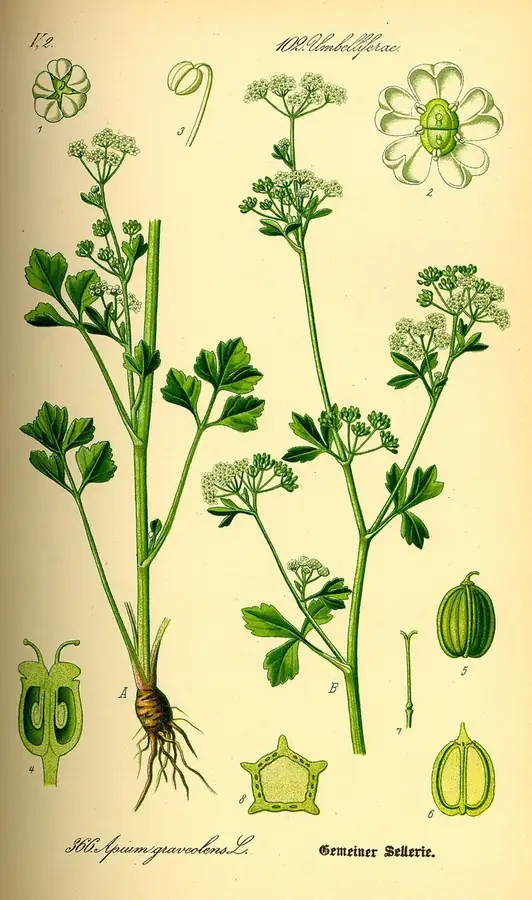
Identity & origin
BOTANICAL IDENTITY
The right name is the first step.
Food species identified by Kew. This profile concerns identity and allergy risk, without attributing a treatment effect to celery regimens.
Also known as: No synonyms listed.
Use identified food-grade celery; wild plants in the same family cannot be reliably identified from a photograph.
An illustration is not enough to identify a plant for consumption. Do not forage for a species based solely on this profile.
Uses & evidence
UNDERSTANDING THE USES
Properties & uses.
Food and flavouring
The presence of celery in the diet does not prove the benefits of a course of treatment, juice or extract. No therapeutic use is recommended here.
The references do not establish a benefit. Lack of evidence is not assurance of safety.
Read the sourceThe traditional uses described are not clinical proof of effectiveness. Evidence for one preparation cannot automatically be applied to another.
Precautions before use
BEFORE ANY USE
Precautions & contraindications.
This guidance does not cover every individual situation. Missing information is not a guarantee of safety.
The following warnings do not constitute a complete review of interactions or contraindications. An unstudied combination cannot be considered compatible.
Contraindications & precautions
- Celery allergy: also avoid products containing it.
Medicine interactions
- The selected data do not allow compatibility with your treatments to be guaranteed. Ask a pharmacist to check.
“Reported” does not prove causality; “possible” may reflect indirect evidence. “None reported” means none in the cited source, not that all combinations have been studied. Do not stop a prescribed treatment based on this profile.
Adverse effects
- Possible allergic reaction, sometimes severe; breathing difficulty or feeling faint: emergency.
Pregnancy & breastfeeding
This profile proposes no concentrate or medicinal dose during pregnancy or breastfeeding.
Children & adolescents
Food allergy also affects children; no paediatric medicinal use suggested.
If symptoms persist, worsen or are unusual, consult a healthcare professional. In an emergency, contact the emergency services.
Forms & how they are used
DOCUMENTED FORMS
One plant, several preparations.
Only forms documented in this profile’s sources are presented.
Leaves and petioles in cookingLeaves and leaf stalks · Route: food
Food use; no medicinal dosage.
Please note: Celery: a food allergen subject to mandatory declaration.
Read the sourceAvailable evidence
EXPLORE THE EVIDENCE
The available evidence.
Celery is primarily a food, but clinical research has studied a seed extract in people with hypertension, as an adjunct to treatment. This preparation corresponds neither to the stalks eaten, nor to celery juice, nor to an essential oil. The result deserves documentation without turning it into a proposal for cardiovascular self-medication.
Constituents to know.
Their presence and quantity depend on the plant part and preparation.
- 3-n-butylphthalide
- The trial report lists this constituent among those in the seed extract. It does not demonstrate that this constituent alone explains the observed response.Read the reference
Blood pressure: clinical signal
24-hour ambulatory measurement provides an objective result. A reduction in a small trial nevertheless demonstrates neither stroke prevention nor equivalence to a prescribed treatment.
A human study may be positive, negative or inconclusive. Read the findings, preparation and limitations.
Read the referenceLimitations to keep in mind.
A person being treated for hypertension should discuss any seed extract with their healthcare professional. The blood-pressure-lowering signal is also a reason to avoid adding it to medicines independently.
Studies, findings & limitations
THE RESEARCH
What the research shows.
A laboratory or animal result alone does not demonstrate a benefit in humans. Each result must be read alongside the preparation studied and its limitations.
Seed extract as an adjunct
A human study may be positive, negative or inconclusive. Read the findings, preparation and limitations.
- Type of research
- Randomized triple-blind placebo-controlled crossover trial; 52 participants complete both phases, 4-week periods
- Preparation concerned
- Apium graveolens seed extract capsules added to hypertension treatment.
- Observed results
- The authors report a reduction in systolic and diastolic blood pressure during the celery phase, with no corresponding significant change on placebo.
- Limitations to consider
- Trial limited in size and duration; no demonstrated effect on cardiovascular complications. The good tolerability observed in this group does not guarantee general safety.
What can we take from this?
These results do not validate juice regimens, drainage claims or use of the leaves as medicine. Celery allergy remains a major consideration, regardless of experimental interest.
Documentary review dated 09/10/2026. The references remain available to check the context.
Sources & last review
CHECKING REFERENCES
Sources for this profile.
- Kew POWO — Apium graveolensAccessed on 09/10/2026
- EFSA — food allergens, including celeryAccessed on 09/10/2026
- Shayani Rad et al. — celery seed extract and blood pressure, crossover trial (2022)Accessed on 09/10/2026
Image: Flora von Deutschland, Österreich und der Schweiz — Otto Wilhelm Thomé (1885), via Wikimedia Commons · Public domain. View the original image and its licence. Image resized and converted to WebP.