
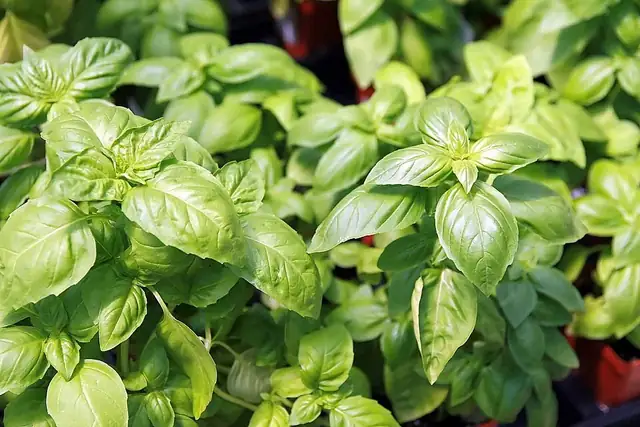
Identity & origin
BOTANICAL IDENTITY
The right name is the first step.
A cultivated culinary herb, distinct from holy basil. The composition of its essential oil varies by chemotype; its culinary use does not justify ingesting a concentrated extract.
Also known as: No synonyms listed.
Do not confuse Ocimum basilicum with Ocimum tenuiflorum; the word “basil” alone does not describe a chemotype.
An illustration is not enough to identify a plant for consumption. Do not forage for a species based solely on this profile.
Uses & evidence
UNDERSTANDING THE USES
Properties & uses.
Culinary herb
Food use of the leaves; concentrated preparations and essential oil are distinct.
The references do not establish a benefit. Lack of evidence is not assurance of safety.
Read the sourceSleep: exploratory clinical research
A small trial of a leaf extract in postmenopausal women reports improved questionnaire scores. This does not validate all preparations or a general treatment for insomnia.
A human study may be positive, negative or inconclusive. Read the findings, preparation and limitations.
Read the sourceThe traditional uses described are not clinical proof of effectiveness. Evidence for one preparation cannot automatically be applied to another.
Precautions before use
BEFORE ANY USE
Precautions & contraindications.
This guidance does not cover every individual situation. Missing information is not a guarantee of safety.
Contraindications & precautions
- Insufficient dataThis targeted audit does not provide a comprehensive contraindication review; this does not mean contraindications are absent.
Medicine interactions
- Insufficient dataThis dossier cannot establish compatibility with medication. A limited study does not replace an interaction review of the exact product.
Other retained warnings · review incomplete
These existing warnings remain relevant to consult. Their exhaustive reassessment is outside this targeted review.
Restrictions and precautions
- Avoid in cases of known allergy. Concentrated preparations require a separate assessment.
Medicine interactions
- The selected data do not allow compatibility with your treatments to be guaranteed. Ask a pharmacist to check.
Pregnancy, breastfeeding and children
No medicinal dose recommendation during pregnancy or breastfeeding; do not extrapolate dietary use to concentrates.
This leaflet proposes no pediatric medicinal use.
“Reported” does not prove causality; “possible” may reflect indirect evidence. “None reported” means none in the cited source, not that all combinations have been studied. Do not stop a prescribed treatment based on this profile.
Adverse effects
- Stop use if an unexpected reaction occurs; limited data do not mean absence of risk.
Pregnancy & breastfeeding
No medicinal dose recommendation during pregnancy or breastfeeding; do not extrapolate dietary use to concentrates.
Children & adolescents
This leaflet proposes no pediatric medicinal use.
If symptoms persist, worsen or are unusual, consult a healthcare professional. In an emergency, contact the emergency services.
Forms & how they are used
DOCUMENTED FORMS
One plant, several preparations.
Only forms documented in this profile’s sources are presented.
Leaves in cookingLeaves · Route: food
Flavoring herb, with no promise of medical benefit.
Please note: Use a plant intended for food.
Read the sourceEssential oil — precautionLeaves · Route: not recommended
ANSES describes chemotypes with different compositions.
Please note: No ingestion at home; it does not replace the leaves.
Read the sourceAvailable evidence
EXPLORE THE EVIDENCE
The available evidence.
Culinary basil and a leaf extract in a capsule are not the same intervention. A small randomized trial studies sleep in postmenopausal women; it provides an interesting but narrow clinical signal. It would be excessive to infer that pesto, an ordinary herbal tea or essential oil treats insomnia, or that the result applies to all ages.
Sleep: a targeted exploratory result
Improved questionnaire scores were observed with a defined oral extract in a specific population. This does not demonstrate a general sedative mechanism for basil.
A human study may be positive, negative or inconclusive. Read the findings, preparation and limitations.
Read the referenceLimitations to keep in mind.
This work helps explain the state of research, without proposing a recipe or dose. Aromatic leaves eaten as part of a meal remain a distinct use from concentrated extracts.
Studies, findings & limitations
THE RESEARCH
What the research shows.
A laboratory or animal result alone does not demonstrate a benefit in humans. Each result must be read alongside the preparation studied and its limitations.
Leaf extract in postmenopausal women
A human study may be positive, negative or inconclusive. Read the findings, preparation and limitations.
- Type of research
- Randomized triple-blind placebo-controlled trial; 60 women aged 40 to 65 years, one month
- Preparation concerned
- Capsules containing an Ocimum basilicum leaf extract.
- Observed results
- Sleep quality and insomnia severity scores improve more in the extract group at the reported assessments.
- Limitations to consider
- Small sample, short duration, questionnaire-based measurements and a specific population; the preparation is not an infusion. No conclusion on prolonged use or the safety of every formulation.
What can we take from this?
The molecular mechanism is not established by this trial. Research on tulsi, Ocimum tenuiflorum, is not attributed to O. basilicum. The signal does not amount to a recommendation to self-treat persistent insomnia.
Documentary review dated 09/10/2026. The references remain available to check the context.
Sources & last review
CHECKING REFERENCES
Sources for this profile.
- Kew POWO — Ocimum basilicumAccessed on 09/10/2026
- ANSES — Opinion 2019-SA-0155 on essential oilsAccessed on 09/10/2026
- Karimi et al. — basil leaf extract and sleep at menopause, randomized trial (2023)Accessed on 09/10/2026
Image: Photo by David J. Stang · CC BY-SA 4.0. View the original image and its licence. Image resized and converted to WebP.