
Identity & origin
BOTANICAL IDENTITY
The right name is the first step.
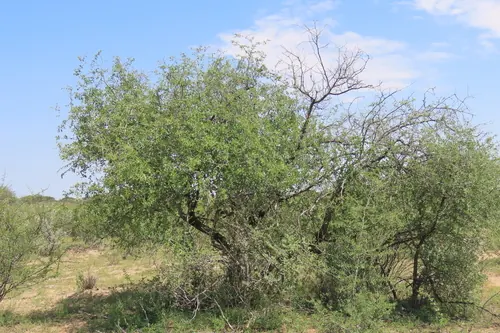
Tree with zigzag young shoots and paired thorns facing in different directions, known as buffalo thorn.
Reading the sources: historical indications are retained as cultural facts, with plant parts specified where legible. Their presence does not establish a confirmed diagnosis, adverse-event frequency or equivalence with a commercial extract. No general conclusion about all human research is drawn from this document selection. Persistent or serious illness requires appropriate care.
Also known as: No synonyms listed.
Parts vary between accounts, and the source concerns subspecies mucronata. The funeral rites also described are not counted as evidence of medical effectiveness.
An illustration is not enough to identify a plant for consumption. Do not forage for a species based solely on this profile.
Uses & evidence
UNDERSTANDING THE USES
Properties & uses.
Reported traditional practices
SANBI reports roots for pain and dysentery, bark and leaves for respiratory complaints, and plant pastes applied to skin lesions. This is an institutional synthesis of reported uses, not a therapeutic trial. An indication appearing in this account demonstrates neither causation nor effectiveness in a patient. Parts vary between accounts, and the source concerns subspecies mucronata. The funeral rites also described are not counted as evidence of medical effectiveness.
Use reported in a survey or inventory. This establishes neither benefit nor safety.
Read the sourceThe traditional uses described are not clinical proof of effectiveness. Evidence for one preparation cannot automatically be applied to another.
Precautions before use
BEFORE ANY USE
Precautions & contraindications.
This guidance does not cover every individual situation. Missing information is not a guarantee of safety.
The following warnings do not constitute a complete review of interactions or contraindications. An unstudied combination cannot be considered compatible.
Contraindications & precautions
- The selected sources are not a complete assessment of human toxicity. Absence of a signal in this account is not a guarantee of safety.
- Before medicinal use, have a health professional check the identity, plant part and personal situation. This entry does not define a preparation for unsupervised use.
Medicine interactions
- Drug interactions are not systematically assessed in the selected sources. Discuss this plant and any product containing it with a doctor or pharmacist before combining treatments.
“Reported” does not prove causality; “possible” may reflect indirect evidence. “None reported” means none in the cited source, not that all combinations have been studied. Do not stop a prescribed treatment based on this profile.
Adverse effects
- The selected sources are not a complete assessment of human toxicity. Absence of a signal in this account is not a guarantee of safety.
Pregnancy & breastfeeding
Pregnancy and breastfeeding: historical accounts are not safety data. Avoid medicinal use without professional assessment, including where an obstetric use appears in the tradition.
Children & adolescents
Children: this entry defines no validated paediatric preparation. Do not convert a historical account involving children into present-day advice or extrapolate adult use.
If symptoms persist, worsen or are unusual, consult a healthcare professional. In an emergency, contact the emergency services.
Sources & last review
CHECKING REFERENCES
Sources for this profile.
- SANBI PlantZAfrica — Ziziphus mucronata — species profile and reported traditional usesAccessed on 09/10/2026
Image: dune_ninja · CC0 1.0. View the original image and its licence. Image resized and converted to WebP.