
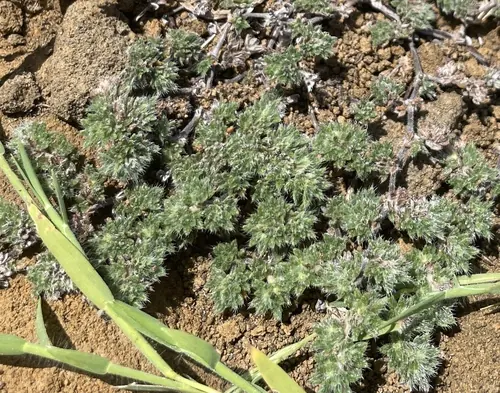
Identity & origin
BOTANICAL IDENTITY
The right name is the first step.
Tiquilia paronychioides is an accepted species in Plants of the World Online, in the Boraginaceae family. Bussmann and Sharon’s survey documents it in northern Peru under the local names Flor de Arena, Paja de Lagartija, Mano de Raton. Recorded material: fresh or dried flowers. The row with JULS154, EHCHL107, ISA58 and GER20 spells the name Tiquilia paronychoides. Kew accepts paronychioides; the original spelling is retained as a lookup variant, not a second species. This entry follows the botanical identity and context of the record; it is not an identification key for collecting plants.
Also known as: Tiquilia paronychoides, Flor de Arena, Paja de Lagartija, Mano de Raton
Check the binomial Tiquilia paronychioides and the actual plant part. The local names Flor de Arena, Paja de Lagartija, Mano de Raton alone do not guarantee botanical identity; properties of a related species cannot be transferred.
An illustration is not enough to identify a plant for consumption. Do not forage for a species based solely on this profile.
Uses & evidence
UNDERSTANDING THE USES
Properties & uses.
Uses reported in northern Peru
A compound flower drink with many other plants is reported for kidney, ovarian or prostate inflammation, bladder stones and urinary infections. Companion ingredients include Malva, Espiga de Maiz and Cola de Caballo. Neither stone passage nor cure of infection is evaluated. These reports establish neither a causal relationship nor clinical effectiveness. Described methods are ethnographic observations, without advice to prepare or take the plant.
Use reported in a survey or inventory. This establishes neither benefit nor safety.
Read the sourceThe traditional uses described are not clinical proof of effectiveness. Evidence for one preparation cannot automatically be applied to another.
Precautions before use
BEFORE ANY USE
Precautions & contraindications.
This guidance does not cover every individual situation. Missing information is not a guarantee of safety.
The following warnings do not constitute a complete review of interactions or contraindications. An unstudied combination cannot be considered compatible.
Contraindications & precautions
- The selected sources provide no complete clinical assessment of contraindications for this species. Their silence does not establish safety.
- Medical or pharmaceutical advice is required before medicinal use, particularly with a chronic condition or persistent symptoms.
Medicine interactions
- Interactions with medicines are not evaluated in the cited ethnobotanical survey. Ask a pharmacist to assess the exact species, plant part and product; do not discontinue prescribed treatment.
“Reported” does not prove causality; “possible” may reflect indirect evidence. “None reported” means none in the cited source, not that all combinations have been studied. Do not stop a prescribed treatment based on this profile.
Adverse effects
- The use inventory contains no monitoring that could establish the frequency or severity of adverse effects. No safe dose is inferred from the described practices.
Pregnancy & breastfeeding
Pregnancy and breastfeeding: the selected sources do not establish safety for this medicinal use. Do not self-medicate; seek appropriate professional advice.
Children & adolescents
Any uses reported in children validate neither safety nor a paediatric dose. Do not independently use this plant medicinally in children; consult a professional.
If symptoms persist, worsen or are unusual, consult a healthcare professional. In an emergency, contact the emergency services.
Sources & last review
CHECKING REFERENCES
Sources for this profile.
- Bussmann & Sharon (2006) — Additional file 1, p. 19, Tiquilia paronychoidesAccessed on 09/10/2026
- Royal Botanic Gardens, Kew — Plants of the World Online: Tiquilia paronychioides (Phil.) A.T.RichardsonAccessed on 09/10/2026
- Bussmann & Sharon (2006) — Traditional medicinal plant use in Northern Peru: tracking two thousand years of healing cultureAccessed on 09/10/2026
Image: Nathaniel Isabella · CC BY 4.0. View the original image and its licence. Image resized and converted to WebP.