
Identity & origin
BOTANICAL IDENTITY
The right name is the first step.
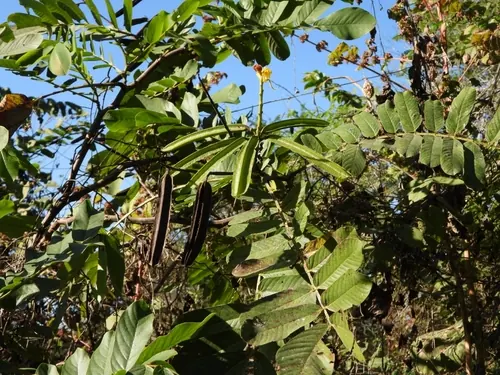
A shrub or tree native from southwestern Mexico through tropical America.
Also known as: Senna alata
The entry concerns the leaf. Senna alata is distinct from the laxative senna Senna alexandrina. A photograph alone cannot certify a plant for consumption.
An illustration is not enough to identify a plant for consumption. Do not forage for a species based solely on this profile.
Uses & evidence
UNDERSTANDING THE USES
Properties & uses.
Documented inventory entry
ANSM List A records: leaf. It inventories traditional use without specifying an indication, dose or clinical benefit here.
The references do not establish a benefit. Lack of evidence is not assurance of safety.
Read the sourceResearch context
Leaf decoction applied topically. Itching and severity decreased; only 40% had negative samples after treatment. Without a comparator efficacy cannot be confirmed; a lesion needs diagnosis.
A human study may be positive, negative or inconclusive. Read the findings, preparation and limitations.
Read the sourceThe traditional uses described are not clinical proof of effectiveness. Evidence for one preparation cannot automatically be applied to another.
Precautions before use
BEFORE ANY USE
Precautions & contraindications.
This guidance does not cover every individual situation. Missing information is not a guarantee of safety.
Contraindications & precautions
- Insufficient dataThis targeted audit does not provide a comprehensive contraindication review; this does not mean contraindications are absent.
Medicine interactions
- Insufficient dataThis dossier cannot establish compatibility with medication. A limited study does not replace an interaction review of the exact product.
Other retained warnings · review incomplete
These existing warnings remain relevant to consult. Their exhaustive reassessment is outside this targeted review.
Restrictions and precautions
- Avoid if allergic to this plant. The sources for this profile do not provide a complete contraindication assessment.
Medicine interactions
- Interactions are not assessed in this profile: have any combination with medication checked.
Pregnancy, breastfeeding and children
Safety information is insufficient to recommend medicinal use during pregnancy or breastfeeding.
This profile establishes no paediatric preparation or dose.
“Reported” does not prove causality; “possible” may reflect indirect evidence. “None reported” means none in the cited source, not that all combinations have been studied. Do not stop a prescribed treatment based on this profile.
Adverse effects
- The selected sources do not establish the frequency of adverse effects.
Pregnancy & breastfeeding
Safety information is insufficient to recommend medicinal use during pregnancy or breastfeeding.
Children & adolescents
This profile establishes no paediatric preparation or dose.
If symptoms persist, worsen or are unusual, consult a healthcare professional. In an emergency, contact the emergency services.
Forms & how they are used
DOCUMENTED FORMS
One plant, several preparations.
Only forms documented in this profile’s sources are presented.
Leaf decoction applied topically.leaf · Route: Topical
Form evaluated in the publication, described to explain the evidence.
Please note: Without a comparator efficacy cannot be confirmed; a lesion needs diagnosis.
Read the sourceAvailable evidence
EXPLORE THE EVIDENCE
The available evidence.
Skin use was investigated in a small exploratory study.
What was measured
The study concerned a specific fungal disease, tinea imbricata.
A human study may be positive, negative or inconclusive. Read the findings, preparation and limitations.
Read the referenceLimitations to keep in mind.
This finding concerns the study preparation; it provides no home-use instructions.
Studies, findings & limitations
THE RESEARCH
What the research shows.
A laboratory or animal result alone does not demonstrate a benefit in humans. Each result must be read alongside the preparation studied and its limitations.
Eusebio-Alpapara et al. — Senna alata and tinea imbricata (2020)
A human study may be positive, negative or inconclusive. Read the findings, preparation and limitations.
- Type of research
- Uncontrolled before-and-after study; 20 people, 4 weeks.
- Preparation concerned
- Leaf decoction applied topically.
- Observed results
- Itching and severity decreased; only 40% had negative samples after treatment.
- Limitations to consider
- Without a comparator efficacy cannot be confirmed; a lesion needs diagnosis.
What can we take from this?
Without a comparator efficacy cannot be confirmed; a lesion needs diagnosis.
Documentary review dated 09/10/2026. The references remain available to check the context.
Sources & last review
CHECKING REFERENCES
Sources for this profile.
- ANSM — Liste A, janvier 2026, page 13Accessed on 09/10/2026
- Kew POWO / MPNS — Senna alataAccessed on 09/10/2026
- Eusebio-Alpapara et al. (2020). Senna (Cassia) alata (Linn.) Roxb. leaf decoction as a treatment for tinea imbricata in an indigenous tribe in Southern Philippines.Accessed on 09/10/2026
Image: Sinaloa Silvestre · CC0 1.0. View the original image and its licence. Image resized and converted to WebP.