BOTANICAL IDENTITY
The right name is the first step.
Also known as: Purple willow
A common name and photograph do not guarantee identification. Check the botanical name and part indicated on a traceable product.
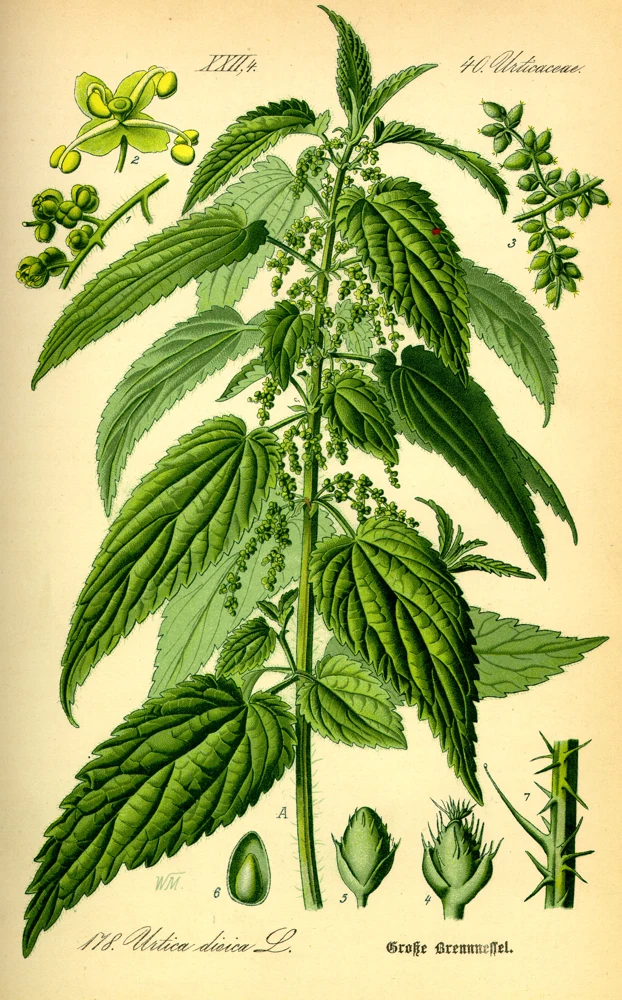
An illustration is not enough to identify a plant for consumption. Do not forage for a species based solely on this profile.
01 · UNDERSTAND
Properties & uses.
Minor joint pain
Shared traditional use; does not demonstrate the efficacy of gathered bark or any individual species.
Read the sourceThe traditional uses described are not clinical proof of effectiveness. Evidence for one preparation cannot automatically be applied to another.
02 · UNDERSTAND THE ACTION
How does the plant act?
Purple willow provides chemically variable bark. Research distinguishes standardized preparations from simple plant material; a species name does not equate to a constant quantity of compounds. The collective monograph therefore does not justify presenting a homemade decoction as equivalent to the extracts studied for certain pains.
Constituents to know.
Their presence and quantity depend on the plant part and preparation.
- Salicylate derivatives and polyphenols
- Analysis of 91 genotypes identifies salicin, salicortin, tremulacin, as well as flavonoids and catechin, with variability between materials.Read the reference
Endothelial inflammatory signaling
A defined aqueous extract reduces TNF-α-induced ICAM-1 expression on cultured human vascular cells. This result does not measure a reduction in pain in a patient.
Read the referenceMinor joint pain
Traditional use for preparations in the group. Results from other extracts do not validate every purple willow bark.
Read the referenceWhat this means for preparation.
A product must specify bark, extraction and standardization. The word “willow” alone describes neither the concentration nor the population studied.
03 · EXAMINE THE EVIDENCE
What the research shows.
A laboratory or animal result alone does not demonstrate a benefit in humans. Each result must be read alongside the preparation studied and its limitations.
One specific extract, several possible constituents
- Type of research
- Experiment on human microvascular cells
- Preparation concerned
- Standardized aqueous extract STW33-I of S. purpurea and constituents tested separately.
- Observed results
- The extract and certain constituents alter the cell adhesion marker ICAM-1.
- Limitations to consider
- The test does not allow the entire effect to be attributed to salicin or an effective herbal tea dose to be identified.
What can we take from this?
A cellular anti-inflammatory property does not prove equivalence to an analgesic medicine. Salicylate-related precautions remain essential.
Documentary review dated 09/10/2026. The references remain available to check the context.
04 · CHOOSE A PREPARATION
One plant, several preparations.
Only forms documented in this profile’s sources are presented.
Bark for herbal teaBark · Route: oral
Preparation described in the shared monograph.
Please note: Follow the product's package leaflet; concentrations are not interchangeable.
Read the sourceExtractBark · Route: oral
Preparation described in the shared monograph.
Please note: Follow the product's package leaflet; concentrations are not interchangeable.
Read the source05 · BEFORE ANY USE
Precautions & contraindications.
This guidance does not cover every individual situation. Missing information is not a guarantee of safety.
Contraindications
- Allergy to salicylates, ulcer, coagulation disorder, G6PD deficiency or severe kidney/liver impairment.
Medicine interactions
- Anticoagulants, antiplatelets and anti-inflammatories: do not combine without advice.
Adverse effects
- Digestive disturbances and allergic reactions.
Pregnancy & breastfeeding
Contraindicated in the third trimester; avoid during pregnancy and breastfeeding without medical advice.
Children & adolescents
Contraindicated under 18 years.
If symptoms persist, worsen or are unusual, consult a healthcare professional. In an emergency, contact the emergency services.
06 · PUTTING KNOWLEDGE INTO PRACTICE
Preparations & recipes.
No home recipe is provided in this profile. For an appropriate preparation, refer to the product leaflet and ask your pharmacist for advice.
07 · CHECK THE SOURCES
Sources for this profile.
- EMA — salicis cortexAccessed on 09/10/2026
- Characterization of bark constituents from 91 Salix purpurea genotypes (2017)Accessed on 09/10/2026
- Salix purpurea extract and ICAM-1 expression in endothelial cells (2011)Accessed on 09/10/2026
- EMA — final assessment of willow barksAccessed on 09/10/2026
Illustration: User:Kurt Stueber · Public domain. View the original image and its licence. Image resized and converted to WebP.
A TOUCH OF SOLÉA
Myriam’s tip
Myriam is reviewing the tip for this profile.
Myriam