
Identity & origin
BOTANICAL IDENTITY
The right name is the first step.
A shrub native to Madeira, northwestern Africa, and Europe eastwards to Central Asia and Pakistan.
Also known as: Rosa canina
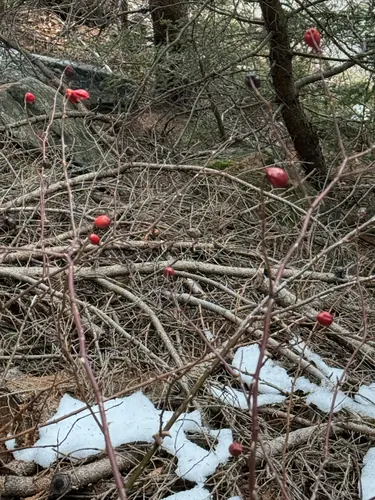
The rose hip is an accessory fruit; it should not inherit claims made for a seed oil from another rose. A photograph alone cannot certify a plant for consumption.
An illustration is not enough to identify a plant for consumption. Do not forage for a species based solely on this profile.
Uses & evidence
UNDERSTANDING THE USES
Properties & uses.
Documented inventory entry
ANSM List A records: rose hip (accessory fruit). It inventories traditional use without specifying an indication, dose or clinical benefit here.
The references do not establish a benefit. Lack of evidence is not assurance of safety.
Read the sourceResearch context
Trials of standardised rosehip powder have produced mixed findings for osteoarthritis pain. One trial was positive, while a recent reanalysis found no primary between-group difference. This does not establish equivalence of tea or cartilage regeneration.
A human study may be positive, negative or inconclusive. Read the findings, preparation and limitations.
Read the sourceThe traditional uses described are not clinical proof of effectiveness. Evidence for one preparation cannot automatically be applied to another.
Precautions before use
BEFORE ANY USE
Precautions & contraindications.
This guidance does not cover every individual situation. Missing information is not a guarantee of safety.
Contraindications & precautions
- Insufficient dataThis targeted audit does not provide a comprehensive contraindication review; this does not mean contraindications are absent.
Medicine interactions
- Insufficient dataThis dossier cannot establish compatibility with medication. A limited study does not replace an interaction review of the exact product.
Other retained warnings · review incomplete
These existing warnings remain relevant to consult. Their exhaustive reassessment is outside this targeted review.
Restrictions and precautions
- Avoid if allergic to this plant. The sources for this profile do not provide a complete contraindication assessment.
Medicine interactions
- Interactions are not assessed in this profile: have any combination with medication checked.
Pregnancy, breastfeeding and children
Safety information is insufficient to recommend medicinal use during pregnancy or breastfeeding.
This profile establishes no paediatric preparation or dose.
“Reported” does not prove causality; “possible” may reflect indirect evidence. “None reported” means none in the cited source, not that all combinations have been studied. Do not stop a prescribed treatment based on this profile.
Adverse effects
- The selected sources do not establish the frequency of adverse effects.
Pregnancy & breastfeeding
Safety information is insufficient to recommend medicinal use during pregnancy or breastfeeding.
Children & adolescents
This profile establishes no paediatric preparation or dose.
If symptoms persist, worsen or are unusual, consult a healthcare professional. In an emergency, contact the emergency services.
Forms & how they are used
DOCUMENTED FORMS
One plant, several preparations.
Only forms documented in this profile’s sources are presented.
Standardised seed-and-husk powder.Rose-hip seeds and husks. · Route: Oral
Form evaluated in the publication, described to explain the evidence.
Please note: Demonstrates neither cartilage regeneration nor equivalence of tea. Results require comparison with other trials.
Read the sourceAvailable evidence
EXPLORE THE EVIDENCE
The available evidence.
Results concern a defined powder, not every rose-hip preparation.
What was measured
Pain and joint mobility were assessed in people with osteoarthritis.
A human study may be positive, negative or inconclusive. Read the findings, preparation and limitations.
Read the referenceLimitations to keep in mind.
This finding concerns the study preparation; it provides no home-use instructions.
Studies, findings & limitations
THE RESEARCH
What the research shows.
A laboratory or animal result alone does not demonstrate a benefit in humans. Each result must be read alongside the preparation studied and its limitations.
Warholm et al. — Standardised rose-hip powder in osteoarthritis (2003)
A human study may be positive, negative or inconclusive. Read the findings, preparation and limitations.
- Type of research
- Placebo-controlled trial; 100 patients, 4 months.
- Preparation concerned
- Standardised seed-and-husk powder.
- Observed results
- The trial reports improved pain and hip mobility.
- Limitations to consider
- Demonstrates neither cartilage regeneration nor equivalence of tea. Results require comparison with other trials.
Motawei et al. — 2026 re-analysis
A human study may be positive, negative or inconclusive. Read the findings, preparation and limitations.
- Type of research
- Re-analysis of a randomised trial, 120 participants.
- Preparation concerned
- Standardised Rosa canina powder.
- Observed results
- No significant between-group difference in WOMAC pain or function; an exploratory body-weight exposure correlation was investigated.
- Limitations to consider
- A secondary analysis alone does not overturn the non-significant primary comparison.
What can we take from this?
Clinical results vary between trials; benefit is neither universal nor established for all preparations.
Documentary review dated 09/10/2026. The references remain available to check the context.
Sources & last review
CHECKING REFERENCES
Sources for this profile.
- ANSM — Liste A, janvier 2026, page 15Accessed on 09/10/2026
- Kew POWO / MPNS — Rosa caninaAccessed on 09/10/2026
- Warholm et al. (2003). The Effects of a Standardized Herbal Remedy Made from a Subtype of Rosa canina in Patients with Osteoarthritis: A Double-Blind, Randomized, Placebo-Controlled Clinical Trial.Accessed on 09/10/2026
- Motawei, Warholm and Winther (2026). Using Dose-Response Correlation Re-Analyzing to Distinguish Placebo from Standardized Rose-Hip Powder (Lito) in a Clinical Trial on Osteoarthritis Where Data Initially Looked Identical.Accessed on 09/10/2026
Image: Codrin Bucur · CC BY 4.0. View the original image and its licence. Image resized and converted to WebP.