
Identity & origin
BOTANICAL IDENTITY
The right name is the first step.
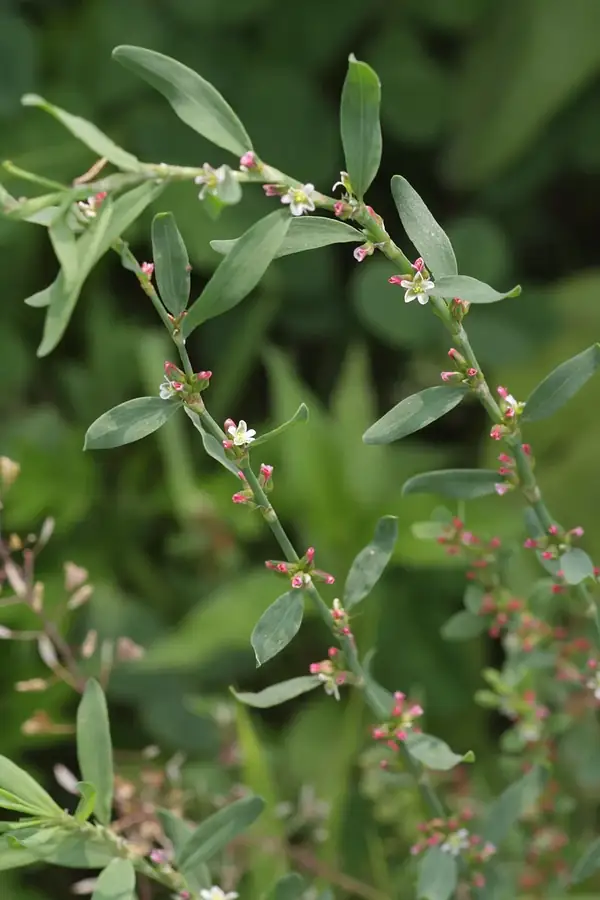
Documentary profile devoted to knotgrass, the part studied and the limits of current knowledge.
Also known as: No synonyms listed.
The botanical name and part used must match the profile; a photograph alone is not sufficient grounds for consuming a plant.
An illustration is not enough to identify a plant for consumption. Do not forage for a species based solely on this profile.
Uses & evidence
UNDERSTANDING THE USES
Properties & uses.
Mouth irritation
An aqueous preparation applied to the mucosa is a traditional use, not a proven treatment for periodontal disease.
Use considered plausible in a traditional-use monograph. That status alone does not demonstrate clinical efficacy.
Read the sourceUrinary comfort
Urinary flushing use aims to increase urine output with fluid intake; it does not demonstrate eradication of an infection.
Use considered plausible in a traditional-use monograph. That status alone does not demonstrate clinical efficacy.
Read the sourceThe traditional uses described are not clinical proof of effectiveness. Evidence for one preparation cannot automatically be applied to another.
Precautions before use
BEFORE ANY USE
Precautions & contraindications.
This guidance does not cover every individual situation. Missing information is not a guarantee of safety.
The following warnings do not constitute a complete review of interactions or contraindications. An unstudied combination cannot be considered compatible.
Contraindications & precautions
- Allergy.
- Urinary use is unsuitable when fluid intake must be reduced, particularly in severe heart or kidney disease.
Medicine interactions
- None reported; check individual treatment.
“Reported” does not prove causality; “possible” may reflect indirect evidence. “None reported” means none in the cited source, not that all combinations have been studied. Do not stop a prescribed treatment based on this profile.
Adverse effects
- No known effects in the monograph; limited data.
Pregnancy & breastfeeding
Pregnancy and breastfeeding: medicinal use is not recommended due to insufficient data.
Children & adolescents
Not recommended under 12 years of age.
If symptoms persist, worsen or are unusual, consult a healthcare professional. In an emergency, contact the emergency services.
Available evidence
EXPLORE THE EVIDENCE
The available evidence.
Common knotgrass has distinct traditional uses: cold symptoms, mouth or throat irritation, and increasing urine volume to support minor urinary complaints. The assessment concerns the flowering aerial parts of Polygonum aviculare. Chemical research describes a variable flavonoid profile; it provides information on raw material quality without itself demonstrating a therapeutic benefit.
Constituents to know.
Their presence and quantity depend on the plant part and preparation.
- Flavonol glucuronides
- Analysis of nine samples showed marked variability in the profile and amount of flavonoids.Read the reference
Mouth irritation
An aqueous preparation applied to the mucosa is a traditional use, not a proven treatment for periodontal disease.
Use considered plausible in a traditional-use monograph. That status alone does not demonstrate clinical efficacy.
Read the referenceUrinary comfort
Urinary flushing use aims to increase urine output with fluid intake; it does not demonstrate eradication of an infection.
Use considered plausible in a traditional-use monograph. That status alone does not demonstrate clinical efficacy.
Read the referenceLimitations to keep in mind.
The flowering part and route of use must remain explicit; oral cavity use is not the same as a herbal tea intended for urinary comfort.
Studies, findings & limitations
THE RESEARCH
What the research shows.
A laboratory or animal result alone does not demonstrate a benefit in humans. Each result must be read alongside the preparation studied and its limitations.
Gingivitis: a still-fragile signal
The references do not establish a benefit. Lack of evidence is not assurance of safety.
- Type of research
- Human study analyzed in the EMA report.
- Preparation concerned
- Knotgrass preparation whose part and preparation method were incompletely described.
- Observed results
- A favorable effect on gingivitis was reported.
- Limitations to consider
- Insufficiently reported methodology prevents a reliable conclusion and reproduction of a protocol.
Quality control
Laboratory or animal observation. A human benefit cannot be inferred from this finding alone.
- Type of research
- UHPLC chromatographic analysis of nine samples, Granica, 2015.
- Preparation concerned
- Marketed or harvested aerial parts of Polygonum aviculare in the broad sense.
- Observed results
- Flavonol glucuronides form a major group in the analyzed profile.
- Limitations to consider
- Identification and standardization study, with no treated participants or clinical measurements.
What can we take from this?
The gingivitis data remain exploratory. No laboratory mechanism here justifies use for diabetes or a urinary tract infection.
Documentary review dated 09/10/2026. The references remain available to check the context.
Sources & last review
CHECKING REFERENCES
Sources for this profile.
- EMA — Polygoni avicularis herba: dossier and documentsAccessed on 09/10/2026
- ANSES — precautions for herbal supplements, June 2023 tableAccessed on 09/10/2026
- Granica, 2015 — standardisation of Polygoni avicularis herbaAccessed on 09/10/2026
- EMA — scientific assessment report: Polygonum aviculareAccessed on 09/10/2026
Image: Dalgial · CC BY-SA 3.0. View the original image and its licence. Image resized and converted to WebP.