
Identity & origin
BOTANICAL IDENTITY
The right name is the first step.
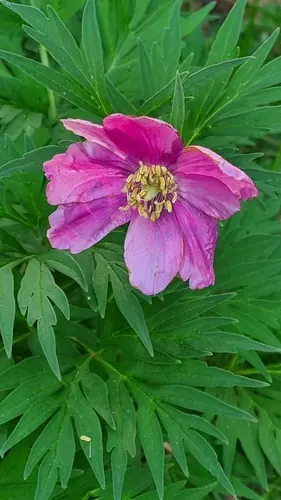
A perennial peony identified by Kew. It appears alongside P. lactiflora in the European red root dossier; the white root dossier concerns a different material.
Also known as: No synonyms listed.
A common name and photograph do not guarantee identification. Check the botanical name and part indicated on a traceable product.
An illustration is not enough to identify a plant for consumption. Do not forage for a species based solely on this profile.
Uses & evidence
UNDERSTANDING THE USES
Properties & uses.
Medicinal uses not established in this profile
The EMA has not established a European monograph: the available evidence did not meet the required criteria. No clinical benefit is asserted here.
The references do not establish a benefit. Lack of evidence is not assurance of safety.
Read the sourceThe traditional uses described are not clinical proof of effectiveness. Evidence for one preparation cannot automatically be applied to another.
Precautions before use
BEFORE ANY USE
Precautions & contraindications.
This guidance does not cover every individual situation. Missing information is not a guarantee of safety.
The following warnings do not constitute a complete review of interactions or contraindications. An unstudied combination cannot be considered compatible.
Contraindications & precautions
- Safety insufficiently characterized: do not begin therapeutic self-treatment.
Medicine interactions
- The selected data do not allow compatibility with your treatments to be guaranteed. Ask a pharmacist to check.
“Reported” does not prove causality; “possible” may reflect indirect evidence. “None reported” means none in the cited source, not that all combinations have been studied. Do not stop a prescribed treatment based on this profile.
Adverse effects
- Stop use if an unexpected reaction occurs; limited data do not mean absence of risk.
Pregnancy & breastfeeding
Pregnancy and breastfeeding: medicinal use is not recommended; insufficient data.
Children & adolescents
Medicinal use is not recommended under 18 years; insufficient data.
If symptoms persist, worsen or are unusual, consult a healthcare professional. In an emergency, contact the emergency services.
Forms & how they are used
DOCUMENTED FORMS
One plant, several preparations.
Only forms documented in this profile’s sources are presented.
Dried root — information referenceRoot · Route: not recommended
Material examined in the dossier, without validated instructions for home use.
Please note: No recipe, dosage or equivalence with white root is proposed.
Read the sourceAvailable evidence
EXPLORE THE EVIDENCE
The available evidence.
Veitch's peony root belongs to the medicinal material called red peony, which must not be confused with all white peony preparations. The EMA has not established a European monograph for this dossier. The absence of this framework does not mean the root is chemically inactive, but precludes presenting its uses as validated by the EMA.
Constituents to know.
Their presence and quantity depend on the plant part and preparation.
- Monoterpene glycosides
- A study of roots from different peonies quantifies compounds in the paeoniflorin family. 4-O-methylpaeoniflorin distinguishes certain materials, including P. veitchii, in this series.Read the reference
Characterization, not a demonstrated indication
A chemical profile helps compare and quality-control roots. It does not demonstrate clinical benefit for pain, a menstrual cycle or an inflammatory disease.
The references do not establish a benefit. Lack of evidence is not assurance of safety.
Read the referenceLimitations to keep in mind.
A traditional root name must be accompanied by the botanical name and its processing. Two powders called peony are not necessarily the same product.
Studies, findings & limitations
THE RESEARCH
What the research shows.
A laboratory or animal result alone does not demonstrate a benefit in humans. Each result must be read alongside the preparation studied and its limitations.
Distinguishing roots by their constituents
Laboratory or animal observation. A human benefit cannot be inferred from this finding alone.
- Type of research
- Comparative analytical study of 56 samples
- Preparation concerned
- Red and white roots and other Paeonia materials; several species compared.
- Observed results
- Quantification of 15 major monoterpenoids and identification of differences between materials.
- Limitations to consider
- No therapeutic trial in patients. A study on purified paeoniflorin or P. lactiflora is not evidence of the efficacy of P. veitchii.
What can we take from this?
No new recipe or dosage follows from this analysis. The presence of molecules studied elsewhere does not compensate for insufficient efficacy and safety data specific to the preparation.
Documentary review dated 09/10/2026. The references remain available to check the context.
Sources & last review
CHECKING REFERENCES
Sources for this profile.
- EMA — paeoniae radix rubraAccessed on 09/10/2026
- EMA — statement on red peony rootAccessed on 09/10/2026
- Kew POWO — Paeonia veitchiiAccessed on 09/10/2026
- Characterisation and quantification of monoterpenoids in different peony roots (2016)Accessed on 09/10/2026
Image: Simon Tonge · CC0 1.0. View the original image and its licence. Image resized and converted to WebP.