
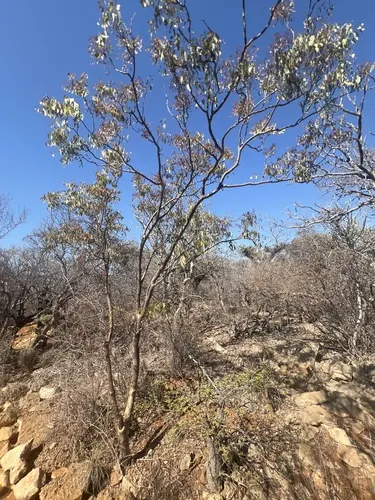
Identity & origin
BOTANICAL IDENTITY
The right name is the first step.
Neobeguea mahafaliensis is recorded as “Andy” in the ethnobotanical inventory of the five surveyed Antananarivo markets, Madagascar. The documented plant material is bark. Voucher: MTR183. The accepted scientific name and family (Meliaceae) were cross-checked against GBIF. This documentary profile does not provide the morphological keys required for harvesting.
Also known as: No synonyms listed.
The local name “Andy” is a survey label, not a unique identification. Check Neobeguea mahafaliensis J.-F.Leroy; a photograph or a similar common name cannot establish identity. Properties must not be transferred from related species.
An illustration is not enough to identify a plant for consumption. Do not forage for a species based solely on this profile.
Uses & evidence
UNDERSTANDING THE USES
Properties & uses.
Reported local use: fatigue and erectile dysfunction
The study records bark under reported uses concerning fatigue and erectile dysfunction. This describes community knowledge; it does not demonstrate treatment efficacy or validate a diagnosis.
Use reported in a survey or inventory. This establishes neither benefit nor safety.
Read the sourceThe traditional uses described are not clinical proof of effectiveness. Evidence for one preparation cannot automatically be applied to another.
Precautions before use
BEFORE ANY USE
Precautions & contraindications.
This guidance does not cover every individual situation. Missing information is not a guarantee of safety.
The following warnings do not constitute a complete review of interactions or contraindications. An unstudied combination cannot be considered compatible.
Contraindications & precautions
- Specific contraindications were not assessed in the cited survey. Their absence from this profile must not be understood as evidence of safety.
Medicine interactions
- Drug interactions have not been established by the source consulted; compatibility with medicines cannot be assumed.
“Reported” does not prove causality; “possible” may reflect indirect evidence. “None reported” means none in the cited source, not that all combinations have been studied. Do not stop a prescribed treatment based on this profile.
Adverse effects
- The survey does not provide systematic adverse-event monitoring for this species; frequency and severity cannot be quantified.
Pregnancy & breastfeeding
Safety in pregnancy and breastfeeding is not established. No medicinal self-use is supported by this profile.
Children & adolescents
No paediatric safety or dose has been verified, including for ages 6–12. Do not give to children on the basis of this documentary record.
If symptoms persist, worsen or are unusual, consult a healthcare professional. In an emergency, contact the emergency services.
Available evidence
EXPLORE THE EVIDENCE
The available evidence.
The verified evidence for Neobeguea mahafaliensis in this profile is ethnobotanical: it links a named species and plant material to reported uses in Madagascar. It is not clinical proof.
Reported use, not a demonstrated pharmacological action
The study records bark under reported uses concerning fatigue and erectile dysfunction. This describes community knowledge; it does not demonstrate treatment efficacy or validate a diagnosis.
Use reported in a survey or inventory. This establishes neither benefit nor safety.
Read the referenceLimitations to keep in mind.
Documentary record only: safety and efficacy have not been established here. Do not self-medicate with this plant or replace medical treatment.
Studies, findings & limitations
THE RESEARCH
What the research shows.
A laboratory or animal result alone does not demonstrate a benefit in humans. Each result must be read alongside the preparation studied and its limitations.
Randriamiharisoa et al. (2015) — Medicinal plants sold in the markets of Antananarivo, Madagascar, table 3
Use reported in a survey or inventory. This establishes neither benefit nor safety.
- Type of research
- Ethnobotanical survey published in 2015: semi-structured interviews with 86 people, including 56 vendors. Plants were purchased and identified, with vouchers deposited at TEF, TAN and MO herbaria. No clinical comparison group.
- Preparation concerned
- Documented material: bark. No standardized preparation with a clinically validated dose is established in this profile.
- Observed results
- The study records bark under reported uses concerning fatigue and erectile dysfunction. This describes community knowledge; it does not demonstrate treatment efficacy or validate a diagnosis. Voucher: MTR183.
- Limitations to consider
- The cited field survey documents reported practices, not changes in patient outcomes. It does not establish an effective dose, treatment duration, mechanism of action or safety margin for this material. No controlled clinical evidence was verified for this profile.
What can we take from this?
The cited field survey documents reported practices, not changes in patient outcomes. It does not establish an effective dose, treatment duration, mechanism of action or safety margin for this material. No controlled clinical evidence was verified for this profile.
Documentary review dated 09/10/2026. The references remain available to check the context.
Sources & last review
CHECKING REFERENCES
Sources for this profile.
- Randriamiharisoa et al. (2015) — Medicinal plants sold in the markets of Antananarivo, Madagascar, tableau 3Accessed on 09/10/2026
- GBIF Backbone Taxonomy — Neobeguea mahafaliensis J.-F.LeroyAccessed on 09/10/2026
Image: Rob Foster · CC BY 4.0. View the original image and its licence. Image resized and converted to WebP.