
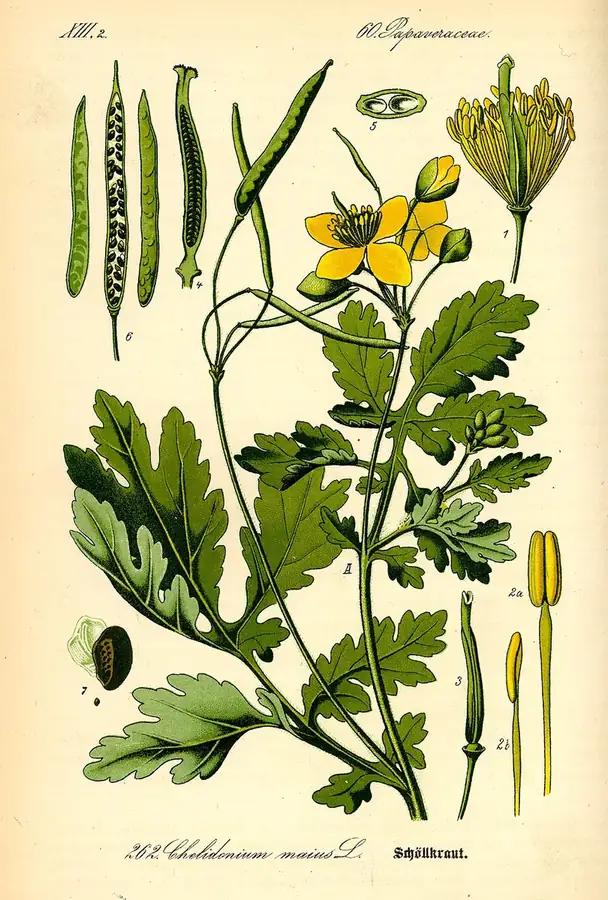
Identity & origin
BOTANICAL IDENTITY
The right name is the first step.
Safety profile: EMA has not adopted a therapeutic monograph for this plant. No homemade preparation is proposed.
Also known as: wartwort
The botanical name, part and preparation must match. A photograph is not enough for identification intended for consumption.
An illustration is not enough to identify a plant for consumption. Do not forage for a species based solely on this profile.
Uses & evidence
UNDERSTANDING THE USES
Properties & uses.
No recommended use
The absence of a monograph does not allow a therapeutic use to be presented as validated.
The references do not establish a benefit. Lack of evidence is not assurance of safety.
Read the sourceThe traditional uses described are not clinical proof of effectiveness. Evidence for one preparation cannot automatically be applied to another.
Precautions before use
BEFORE ANY USE
Precautions & contraindications.
This guidance does not cover every individual situation. Missing information is not a guarantee of safety.
The following warnings do not constitute a complete review of interactions or contraindications. An unstudied combination cannot be considered compatible.
Contraindications & precautions
- Do not use in cases of known allergy to this plant.
Medicine interactions
- Interactions are not detailed here: have a pharmacist check treatments and the preparation.
“Reported” does not prove causality; “possible” may reflect indirect evidence. “None reported” means none in the cited source, not that all combinations have been studied. Do not stop a prescribed treatment based on this profile.
Adverse effects
- This entry does not provide an exhaustive list of adverse effects.
Pregnancy & breastfeeding
Pregnancy and breastfeeding: have the preparation checked; no self-medication is proposed here.
Children & adolescents
No pediatric use is proposed here; check with a professional.
If symptoms persist, worsen or are unusual, consult a healthcare professional. In an emergency, contact the emergency services.
Available evidence
EXPLORE THE EVIDENCE
The available evidence.
Greater celandine has experimental biological activities, but the HMPC judged its oral benefit–risk balance to be negative. The central issue is liver risk, together with insufficiently demonstrated clinical effectiveness. The term “active plant” is therefore not synonymous with a plant suitable for use. This entry explains the research and risks; it suggests no unsupervised therapeutic use.
Constituents to know.
Their presence and quantity depend on the plant part and preparation.
- Alkaloids
- Certain alkaloids, including sanguinarine and chelerythrine, have been the subject of pharmacological and toxicological research. Their presence does not make it possible to identify a safe homemade preparation.Read the reference
Antiviral and cellular activities
Extracts or isolated substances have acted in microbial or cellular models. This experimental level does not demonstrate an antiviral or anticancer treatment in humans.
Laboratory or animal observation. A human benefit cannot be inferred from this finding alone.
Read the referenceLiver safety
Hepatobiliary adverse effects and marketing restrictions weighed on the assessment. Low acute experimental toxicity does not guarantee safety with repeated use.
A human study may be positive, negative or inconclusive. Read the findings, preparation and limitations.
Read the referenceLimitations to keep in mind.
Do not consider fresh latex a gentler version of a formulated product. A suspected wart may need to be identified, and results from mixtures remain unattributable to one ingredient.
Studies, findings & limitations
THE RESEARCH
What the research shows.
A laboratory or animal result alone does not demonstrate a benefit in humans. Each result must be read alongside the preparation studied and its limitations.
Unfavorable benefit–risk balance for oral use
This entry describes a risk or interaction, not a beneficial property.
- Type of research
- EMA report examining pharmacology, human studies and pharmacovigilance.
- Preparation concerned
- Aerial parts, extracts and certain isolated alkaloids.
- Observed results
- Small clinical studies are insufficient, while liver concerns persist.
- Limitations to consider
- The data do not allow a reassuring oral quantity to be set here; no dose is proposed.
What can we take from this?
Folk uses for warts do not validate home application of the latex. No digestive, hepatic or antiviral promise should be drawn from these experiments.
Documentary review dated 09/10/2026. The references remain available to check the context.
Sources & last review
CHECKING REFERENCES
Sources for this profile.
- EMA — Chelidonii herba: official dossierAccessed on 09/10/2026
- EMA — assessment report on Chelidonium majus L. (Aerial parts)Accessed on 09/10/2026
Image: Flora von Deutschland, Österreich und der Schweiz — Otto Wilhelm Thomé (1885), via Wikimedia Commons · Public domain. View the original image and its licence. Image resized and converted to WebP.