Identity & origin
BOTANICAL IDENTITY
The right name is the first step.
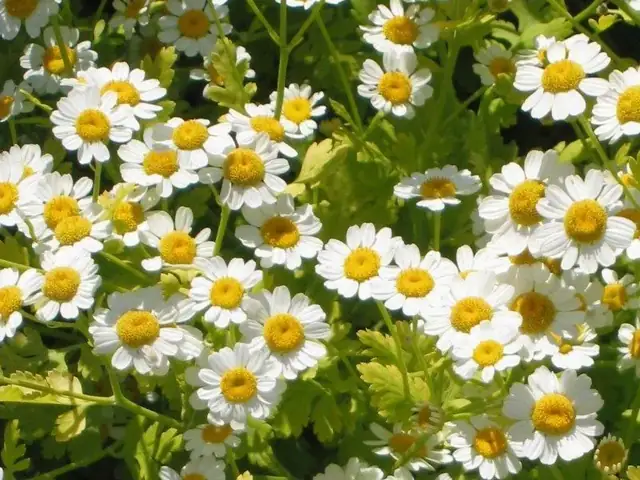
Feverfew: guidance on the aerial parts, with the uses and precautions specific to the documented preparations.
Also known as: feverfew
Distinct from Matricaria recutita and Chamaemelum nobile.
An illustration is not enough to identify a plant for consumption. Do not forage for a species based solely on this profile.
Uses & evidence
UNDERSTANDING THE USES
Properties & uses.
Migraine prevention
Traditional use after a doctor has excluded a serious condition; does not treat a neurological emergency.
Use considered plausible in a traditional-use monograph. That status alone does not demonstrate clinical efficacy.
Read the sourceThe traditional uses described are not clinical proof of effectiveness. Evidence for one preparation cannot automatically be applied to another.
Precautions before use
BEFORE ANY USE
Precautions & contraindications.
This guidance does not cover every individual situation. Missing information is not a guarantee of safety.
Contraindications & precautions
- Source-listed contraindicationAllergy to the plant or other Asteraceae.Source
- PrecautionBefore scheduled surgery: disclose use; NCCIH recommends stopping at least two weeks beforehand.Source
Medicine interactions
- Possible interactionPossible effect on clotting and possible drug interactions: specifically review anticoagulants/antiplatelets and migraine medicines. Risk is not quantified for each combination.Source
“Reported” does not prove causality; “possible” may reflect indirect evidence. “None reported” means none in the cited source, not that all combinations have been studied. Do not stop a prescribed treatment based on this profile.
Adverse effects
- Digestive disturbances reported.
Pregnancy & breastfeeding
Pregnancy: do not use; NCCIH warns of possible effects on uterine contractions. Breastfeeding: insufficient data, use not recommended.
SourceChildren & adolescents
Medicinal use is not recommended below 18 years because data are insufficient; adult preparations and doses cannot be extrapolated.
SourceIf symptoms persist, worsen or are unusual, consult a healthcare professional. In an emergency, contact the emergency services.
Forms & how they are used
DOCUMENTED FORMS
One plant, several preparations.
Only forms documented in this profile’s sources are presented.
Powder in solid dosage formAerial parts · Route: oral
Powdered aerial parts.
Please note: The dossier does not validate an equivalent herbal tea.
Read the sourceUnderstanding the plant’s actions
EXPLORE THE EVIDENCE
How does the plant act?
Feverfew, Tanacetum parthenium, is studied for migraine prevention, not immediate treatment of an attack. Trials have used aerial-part powder or very different extracts, making results difficult to combine. The EMA retains a traditional indication for the powder, without transferring all results from particular extracts to this form.
Constituents to know.
Their presence and quantity depend on the plant part and preparation.
- Parthenolide and other sesquiterpene lactones
- Substances studied for effects on inflammatory or platelet pathways; they may also contribute to contact allergies.Read the reference
Traditional migraine prevention
Use is considered after medical identification of migraine; it does not extend to every headache.
Use considered plausible in a traditional-use monograph. That status alone does not demonstrate clinical efficacy.
Read the referenceWhat this means for preparation.
Look for Tanacetum parthenium: it is not German chamomile. Any combination with medicines affecting coagulation must be discussed; the interaction risk mentioned remains mainly theoretical.
Studies, findings & limitations
THE RESEARCH
What the research shows.
A laboratory or animal result alone does not demonstrate a benefit in humans. Each result must be read alongside the preparation studied and its limitations.
Noninterchangeable preparations
The references do not establish a benefit. Lack of evidence is not assurance of safety.
- Type of research
- EMA assessment of controlled trials of powder and extracts, including MIG-99.
- Preparation concerned
- Aerial parts of Tanacetum parthenium, with different extraction processes and contents.
- Observed results
- Some trials have shown favorable results for migraine frequency; other results are less conclusive.
- Limitations to consider
- Heterogeneous preparations and methodological limitations: a particular extract does not prove the effect of a powder or herbal tea.
What can we take from this?
The plant is not an emergency treatment for a sudden or unusual headache. The marker parthenolide alone does not guarantee a clinical response.
Documentary review dated 09/10/2026. The references remain available to check the context.
Sources & last review
CHECKING REFERENCES
Sources for this profile.
- EMA — Tanaceti parthenii herba: dossier and documentsAccessed on 09/10/2026
- EMA — monographie finale, indication et sections 4.3 à 4.8 reluesAccessed on 09/10/2026
- ANSES — precautions for herbal supplements, June 2023 tableAccessed on 09/10/2026
- EMA — scientific assessment report: Tanacetum partheniumAccessed on 09/10/2026
- NCCIH — Feverfew, février 2025Accessed on 09/10/2026
Image: Vsion (2005) — Wikimedia Commons · CC BY 2.5. View the original image and its licence. Image resized and converted to WebP.