
Identity & origin
BOTANICAL IDENTITY
The right name is the first step.
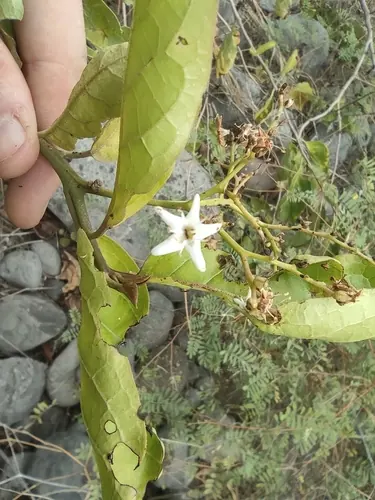
Ehretia cymosa is a shrub or tree in Boraginaceae, linked here to the name accepted by Plants of the World Online. The table gives the local name “Game”. This profile preserves a report of traditional medical knowledge from Ankober, linked in the supplementary table to voucher ErmiasL 843. This text alone is not sufficient for field identification.
Also known as: Game, Ehertia cymosa Thonn.
Retained placenta is the sole indication in this row. The survey does not evaluate maternal safety, bleeding or birth outcomes; this situation requires urgent obstetric care.
An illustration is not enough to identify a plant for consumption. Do not forage for a species based solely on this profile.
Uses & evidence
UNDERSTANDING THE USES
Properties & uses.
Reported use: retained placenta
In Ankober, the survey records roots (fresh material) for “retained placenta”. The table describes a decoction, with the oral route recorded. This is a reported practice, with no causal demonstration or clinical validation in this survey. Retained placenta requires urgent obstetric care; do not reproduce this remedy.
Use reported in a survey or inventory. This establishes neither benefit nor safety.
Read the sourceThe traditional uses described are not clinical proof of effectiveness. Evidence for one preparation cannot automatically be applied to another.
Precautions before use
BEFORE ANY USE
Precautions & contraindications.
This guidance does not cover every individual situation. Missing information is not a guarantee of safety.
The following warnings do not constitute a complete review of interactions or contraindications. An unstudied combination cannot be considered compatible.
Contraindications & precautions
- Species-specific contraindications were not systematically assessed in the selected sources. This lack of assessment does not establish safety; obtain medical or pharmaceutical advice before medicinal use.
Medicine interactions
- Drug interactions were not evaluated in this survey. Have any proposed use checked against regular medicines, without stopping them.
“Reported” does not prove causality; “possible” may reflect indirect evidence. “None reported” means none in the cited source, not that all combinations have been studied. Do not stop a prescribed treatment based on this profile.
Adverse effects
- The table supplies no adverse-event rate or toxicological monitoring for this species. External, nasal or mucosal administration is not presumed safe.
Pregnancy & breastfeeding
Pregnancy and breastfeeding: do not self-treat with this plant. The source does not establish maternal, fetal or infant safety; seek professional advice.
Children & adolescents
No home paediatric use is proposed. The survey establishes neither an age-appropriate dose nor child safety; do not extrapolate practices reported for adults.
If symptoms persist, worsen or are unusual, consult a healthcare professional. In an emergency, contact the emergency services.
Available evidence
EXPLORE THE EVIDENCE
The available evidence.
This profile combines the POWO botanical identity of Ehretia cymosa with an original inventory of human uses. It records what participants reported, not a tested medicine.
Local reports without inferred pharmacological action
Appendix row 46 records 1 indication/preparation pairing(s) for this plant. The number of reports or the age of a practice does not measure treatment effect.
Use reported in a survey or inventory. This establishes neither benefit nor safety.
Read the referenceLimitations to keep in mind.
Read the botanical name together with the voucher number, harvested organ and reported route. A tea, extract, oil and raw plant are not assumed equivalent.
Studies, findings & limitations
THE RESEARCH
What the research shows.
A laboratory or animal result alone does not demonstrate a benefit in humans. Each result must be read alongside the preparation studied and its limitations.
Ankober field survey (2009–2013)
Use reported in a survey or inventory. This establishes neither benefit nor safety.
- Type of research
- Semi-structured interviews, group discussions, observation and botanical walks with 352 informants, including 88 key informants. Field collection occurred in 2009–2011, with verification and market work in 2012–2013; vouchers were deposited at the ETH National Herbarium in Addis Ababa.
- Preparation concerned
- Organs coded in the row: roots. Methods and routes are retained as historical descriptions; no quantity, home recipe or course length is proposed.
- Observed results
- Pairings recorded in the table: retained placenta — roots.
- Limitations to consider
- Descriptive survey: this protocol provides no comparison group, verified clinical diagnosis or treatment-effect follow-up. Disease terms reflect the authors’ and informants’ classification. This profile does not claim to inventory all research on the species.
What can we take from this?
These selected sources establish neither a safe dose nor a benefit–risk balance. Unassessed plant parts, commercial products and mixtures cannot receive the same conclusions merely because their names are similar.
Documentary review dated 09/10/2026. The references remain available to check the context.
Sources & last review
CHECKING REFERENCES
Sources for this profile.
- Royal Botanic Gardens, Kew — Plants of the World Online: Ehretia cymosa Thonn.Accessed on 09/10/2026
- Lulekal et al. (2013) — Additional file 1, Appendix 1, row 46: Ehertia cymosa Thonn.Accessed on 09/10/2026
- Lulekal, Asfaw, Kelbessa & Van Damme (2013). Ethnomedicinal study of plants used for human ailments in Ankober District, North Shewa Zone, Amhara Region, EthiopiaAccessed on 09/10/2026
Image: Augustin Soulard · CC BY 4.0. View the original image and its licence. Image resized and converted to WebP.