
Identity & origin
BOTANICAL IDENTITY
The right name is the first step.
Daucus carota L. belongs to Apiaceae. The survey in Malícia, Araçagi municipality, Paraíba (Brazil) records this herbaceous plant under the local name “Cenoura”; the recorded parts are roots. This entry describes that ethnobotanical record and is not an identification key.
Also known as: Cenoura
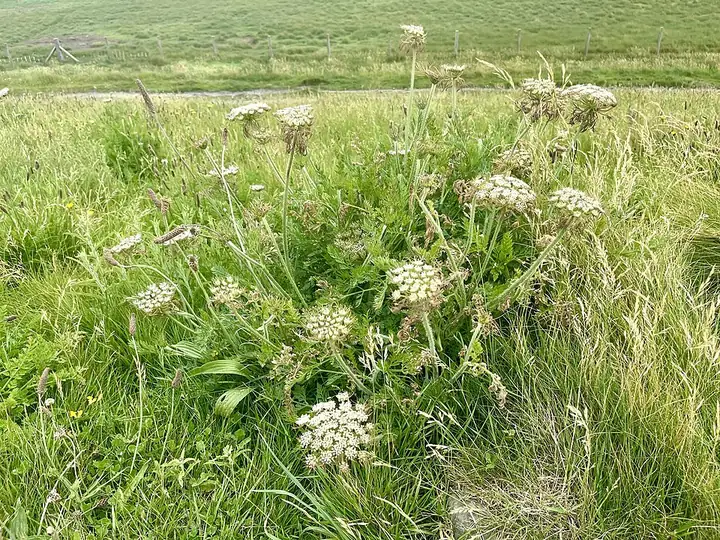
The local name “Cenoura” alone does not identify Daucus carota. Verify botanical identity; do not transfer uses from a namesake or another species of the same genus. A photograph alone cannot establish identity for consumption.
An illustration is not enough to identify a plant for consumption. Do not forage for a species based solely on this profile.
Uses & evidence
UNDERSTANDING THE USES
Properties & uses.
Documented local use: “intestinal detoxification”, the informants’ expression
Table 1 links Daucus carota to the following reported uses: “intestinal detoxification”, the informants’ expression. Recorded parts: roots. Preparations described by informants: juice. These are field reports, with no measured therapeutic outcome.
Use reported in a survey or inventory. This establishes neither benefit nor safety.
Read the sourceThe traditional uses described are not clinical proof of effectiveness. Evidence for one preparation cannot automatically be applied to another.
Precautions before use
BEFORE ANY USE
Precautions & contraindications.
This guidance does not cover every individual situation. Missing information is not a guarantee of safety.
The following warnings do not constitute a complete review of interactions or contraindications. An unstudied combination cannot be considered compatible.
Contraindications & precautions
- The cited source does not systematically assess contraindications. Missing data do not mean absence of risk.
- “Detoxification” and “blood-cleansing” are expressions in the recorded accounts, not evidence of toxin removal in humans.
Medicine interactions
- Drug interactions were not evaluated in this survey. Do not combine with medication without medical or pharmaceutical advice.
“Reported” does not prove causality; “possible” may reflect indirect evidence. “None reported” means none in the cited source, not that all combinations have been studied. Do not stop a prescribed treatment based on this profile.
Adverse effects
- The cited study does not establish the frequency or severity of adverse effects; this information gap does not guarantee safety.
Pregnancy & breastfeeding
Safety during pregnancy or breastfeeding is not established; no medicinal use is recommended in this entry.
Children & adolescents
The cited source provides no validated paediatric safety data or dose; do not self-administer to children, including ages 6–12.
If symptoms persist, worsen or are unusual, consult a healthcare professional. In an emergency, contact the emergency services.
Available evidence
EXPLORE THE EVIDENCE
The available evidence.
Table 1 links Daucus carota to the following reported uses: “intestinal detoxification”, the informants’ expression. Recorded parts: roots. Preparations described by informants: juice. These are field reports, with no measured therapeutic outcome.
Reported use, unproven action
This survey establishes neither a mechanism of action, clinical efficacy nor safety. A local report cannot be extrapolated to all preparations or to related species. This entry validates no dose.
Use reported in a survey or inventory. This establishes neither benefit nor safety.
Read the referenceLimitations to keep in mind.
Reported ethnobotanical use, not a treatment recommendation. Safety and efficacy are not established by the source; do not self-medicate.
Studies, findings & limitations
THE RESEARCH
What the research shows.
A laboratory or animal result alone does not demonstrate a benefit in humans. Each result must be read alongside the preparation studied and its limitations.
Ethnobotanical record — Malícia, Araçagi municipality, Paraíba (Brazil)
Use reported in a survey or inventory. This establishes neither benefit nor safety.
- Type of research
- Ethnobotanical survey using semistructured interviews with 46 household heads; reported indications, plant parts and preparations were recorded. RI and ICF measure versatility and agreement in use reports, not therapeutic efficacy.
- Preparation concerned
- Reported forms: juice. Parts: roots. Documentary description without a home-use protocol or assumed equivalence between forms.
- Observed results
- Table 1 links Daucus carota to the following reported uses: “intestinal detoxification”, the informants’ expression. Recorded parts: roots. Preparations described by informants: juice. These are field reports, with no measured therapeutic outcome.
- Limitations to consider
- This survey establishes neither a mechanism of action, clinical efficacy nor safety. A local report cannot be extrapolated to all preparations or to related species. This entry validates no dose.
What can we take from this?
This survey establishes neither a mechanism of action, clinical efficacy nor safety. A local report cannot be extrapolated to all preparations or to related species. This entry validates no dose.
Documentary review dated 09/10/2026. The references remain available to check the context.
Sources & last review
CHECKING REFERENCES
Sources for this profile.
- Ferreira et al. (2021) — Local Knowledge and Use of Medicinal Plants in a Rural Community in the Agreste of Paraíba, Northeast Brazil — tableau 1Accessed on 09/10/2026
- GBIF Backbone Taxonomy — Daucus carota L.Accessed on 09/10/2026
Image: Kieran Roy Powell · CC BY 4.0. View the original image and its licence. Image resized and converted to WebP.