
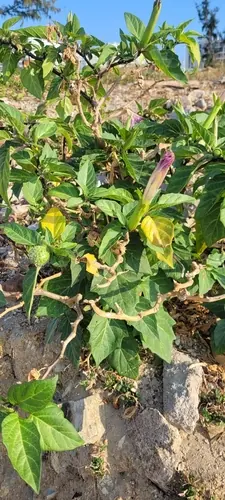
Identity & origin
BOTANICAL IDENTITY
The right name is the first step.
Datura metel is documented in Kew’s SEPASAL inventory. This notice identifies the taxon and a selection of attributed historical uses. It does not recommend medicinal use.
Also known as: Datura metel L., Datura fastuosa L., Datura alba Rumph. ex Nees, Datura cornucopaea Hort. ex W.W.
The accepted name is reconciled with GBIF; historical source names remain visible as synonyms. Other species and plant parts are not interchangeable. A photograph cannot confirm an identification for consumption.
An illustration is not enough to identify a plant for consumption. Do not forage for a species based solely on this profile.
Uses & evidence
UNDERSTANDING THE USES
Properties & uses.
Historical record: motion sickness
SEPASAL records an earlier use involving leaves under “motion sickness” (use group 31668). This is a documentary report, not a demonstrated action in humans. The entry does not establish an effective dose, safety or a suitable home preparation. The original publications are cited by Kew; they have not all been consulted directly.
Use reported in a survey or inventory. This establishes neither benefit nor safety.
Read the sourceHistorical record: motion sickness
SEPASAL records an earlier use involving flowers under “motion sickness” (use group 32472). This is a documentary report, not a demonstrated action in humans. The entry does not establish an effective dose, safety or a suitable home preparation. The original publications are cited by Kew; they have not all been consulted directly.
Use reported in a survey or inventory. This establishes neither benefit nor safety.
Read the sourceHistorical record: fever
SEPASAL records an earlier use involving leaves under “fever” (use group 13461). This is a documentary report, not a demonstrated action in humans. The entry does not establish an effective dose, safety or a suitable home preparation. The original publications are cited by Kew; they have not all been consulted directly.
Use reported in a survey or inventory. This establishes neither benefit nor safety.
Read the sourceThe traditional uses described are not clinical proof of effectiveness. Evidence for one preparation cannot automatically be applied to another.
Precautions before use
BEFORE ANY USE
Precautions & contraindications.
This guidance does not cover every individual situation. Missing information is not a guarantee of safety.
The following warnings do not constitute a complete review of interactions or contraindications. An unstudied combination cannot be considered compatible.
Contraindications & precautions
- Toxicity is reported in SEPASAL. No home preparation or ingestion.
- A complete clinical contraindication assessment is not available in the references used here. Missing information is not evidence of safety.
- The whole plant is poisonous, especially flowers and seeds. An infusion does not make its use safe.
Medicine interactions
- Interactions have not been systematically assessed in this historical inventory. Compatibility with medicines cannot be established.
“Reported” does not prove causality; “possible” may reflect indirect evidence. “None reported” means none in the cited source, not that all combinations have been studied. Do not stop a prescribed treatment based on this profile.
Adverse effects
- Tropane alkaloids may cause anticholinergic poisoning: dry mouth, rapid heartbeat, urinary retention and confusion; severe poisoning can be fatal.
Pregnancy & breastfeeding
Safety during pregnancy and breastfeeding is not established here. No medicinal use is recommended.
Children & adolescents
No paediatric preparation or dose is validated by this notice. Do not extrapolate historical adult uses to children.
If symptoms persist, worsen or are unusual, consult a healthcare professional. In an emergency, contact the emergency services.
Sources & last review
CHECKING REFERENCES
Sources for this profile.
- SEPASAL, use group 13461 — Royal Botanic Gardens, Kew — . — Information from labels attached to RBG Kew Herbarium specimensAccessed on 09/10/2026
- GBIF — Datura metel L.Accessed on 09/10/2026
- Hong Kong Hospital Authority — Atlas of Poisonous Plants: Datura metelAccessed on 09/10/2026
Image: Pavel Smirnov · CC BY 4.0. View the original image and its licence. Image resized and converted to WebP.