
Identity & origin
BOTANICAL IDENTITY
The right name is the first step.
Species in the Lauraceae family. Recorded native range: Southeastern China to Vietnam. The listed pharmacopoeial material is stem bark.
Also known as: Cinnamomum cassia (ambiguous common usage), cassia
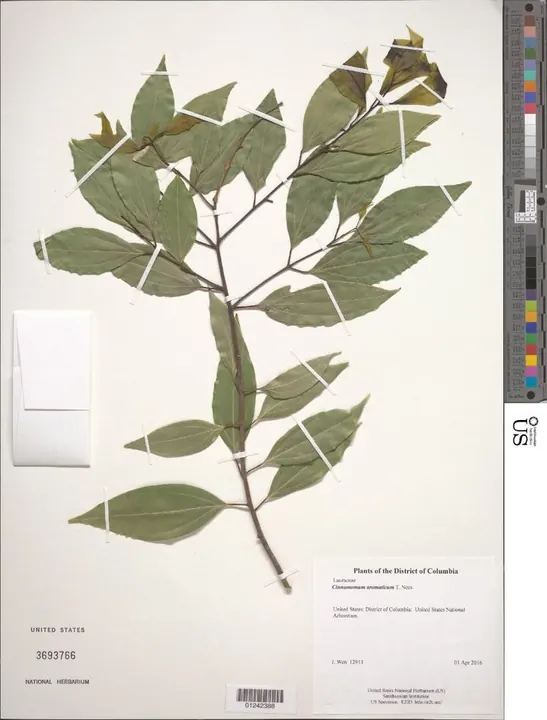
Check the species, plant part and complete botanical name together. A photograph alone cannot identify a harvest safely for consumption.
An illustration is not enough to identify a plant for consumption. Do not forage for a species based solely on this profile.
Uses & evidence
UNDERSTANDING THE USES
Properties & uses.
Pharmacopoeial material: stem bark
This notice uses Cinnamomum aromaticum Nees, Kew’s accepted Chinese-cinnamon name. Cassia has botanical homonyms and must be interpreted with its author and source. This notice infers no therapeutic indication.
The references do not establish a benefit. Lack of evidence is not assurance of safety.
Read the sourceBlood glucose and other claims: clinical limits
NCCIH finds the evidence insufficiently clear to support use for a health condition. Studies often involve poorly specified species, parts or preparations and do not automatically validate this cinnamon.
The references do not establish a benefit. Lack of evidence is not assurance of safety.
Read the sourceThe traditional uses described are not clinical proof of effectiveness. Evidence for one preparation cannot automatically be applied to another.
Precautions before use
BEFORE ANY USE
Precautions & contraindications.
This guidance does not cover every individual situation. Missing information is not a guarantee of safety.
The following warnings do not constitute a complete review of interactions or contraindications. An unstudied combination cannot be considered compatible.
Contraindications & precautions
- With liver disease, have any concentrated or prolonged cassia-cinnamon use reviewed before starting.
Medicine interactions
- Interactions have not been sufficiently assessed in the sources retained for this notice; an incomplete assessment guarantees no compatibility.
“Reported” does not prove causality; “possible” may reflect indirect evidence. “None reported” means none in the cited source, not that all combinations have been studied. Do not stop a prescribed treatment based on this profile.
Adverse effects
- Large amounts may cause digestive upset or allergic reactions; coumarin-containing products require liver-safety caution.
Pregnancy & breastfeeding
Food amounts do not validate concentrated supplements during pregnancy or breastfeeding; no medicinal use is offered here.
Children & adolescents
No paediatric preparation or dose is offered in this notice.
If symptoms persist, worsen or are unusual, consult a healthcare professional. In an emergency, contact the emergency services.
Available evidence
EXPLORE THE EVIDENCE
The available evidence.
“Cassia” covers products of variable composition. This notice retains Cinnamomum aromaticum to avoid ambiguity in cassia name authorship.
Coumarin and the liver
BfR distinguishes relatively coumarin-rich cassia cinnamons from usually lower-coumarin Ceylon cinnamon. Susceptible people can experience coumarin-related liver injury.
The references do not establish a benefit. Lack of evidence is not assurance of safety.
Read the referenceLimitations to keep in mind.
Do not replace blood-glucose treatment with cinnamon capsules.
Studies, findings & limitations
THE RESEARCH
What the research shows.
A laboratory or animal result alone does not demonstrate a benefit in humans. Each result must be read alongside the preparation studied and its limitations.
Coumarin and the liver
The references do not establish a benefit. Lack of evidence is not assurance of safety.
- Type of research
- Agency information based on risk assessment, not an efficacy trial.
- Preparation concerned
- Cinnamons and coumarin: batch concentration matters.
- Observed results
- A familiar spice can produce a different exposure as a concentrated supplement.
- Limitations to consider
- No universal concentration or safe dose is assigned to an unanalysed product.
What can we take from this?
No universal concentration or safe dose is assigned to an unanalysed product.
Documentary review dated 09/10/2026. The references remain available to check the context.
Sources & last review
CHECKING REFERENCES
Sources for this profile.
- ANSM — French Pharmacopoeia, List A, January 2026, p. 9Accessed on 09/10/2026
- Kew POWO — Cinnamomum aromaticum NeesAccessed on 09/10/2026
- NCCIH — Cinnamon (accessed 2026)Accessed on 09/10/2026
- BfR — FAQ on coumarin in cinnamon and other foods (2012)Accessed on 09/10/2026
Image: Smithsonian Institution, NMNH, Botany · CC0 1.0. View the original image and its licence. Image resized and converted to WebP.