
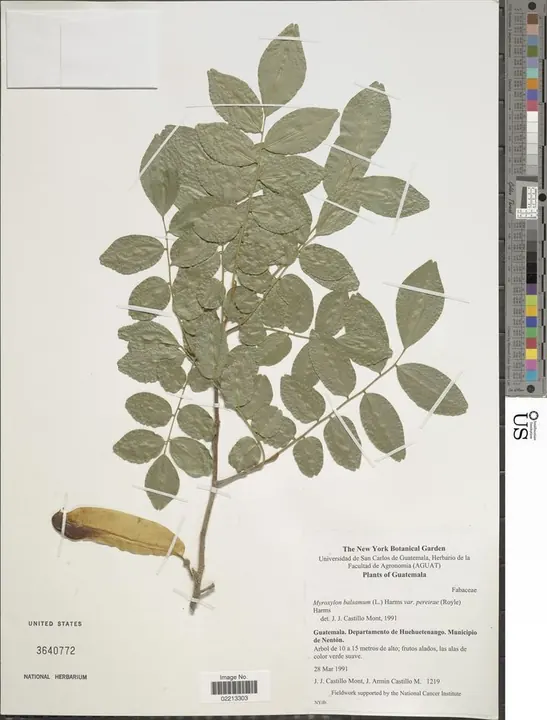
Identity & origin
BOTANICAL IDENTITY
The right name is the first step.
This profile covers the balsam (exudate). The uses described depend on the preparation.
Also known as: Balsam of Peru, Myroxylon pereirae
The EMA dossier concerns variety pereirae; do not confuse it with Tolu balsam.
An illustration is not enough to identify a plant for consumption. Do not forage for a species based solely on this profile.
Uses & evidence
UNDERSTANDING THE USES
Properties & uses.
Insufficient evidence
The HMPC has not adopted a European therapeutic monograph. This leaflet does not recommend any treatment.
The references do not establish a benefit. Lack of evidence is not assurance of safety.
Read the sourceThe traditional uses described are not clinical proof of effectiveness. Evidence for one preparation cannot automatically be applied to another.
Precautions before use
BEFORE ANY USE
Precautions & contraindications.
This guidance does not cover every individual situation. Missing information is not a guarantee of safety.
The following warnings do not constitute a complete review of interactions or contraindications. An unstudied combination cannot be considered compatible.
Contraindications & precautions
- Allergy to Peru balsam: avoid all exposure.
Medicine interactions
- Interactions are not sufficiently established in this profile.
“Reported” does not prove causality; “possible” may reflect indirect evidence. “None reported” means none in the cited source, not that all combinations have been studied. Do not stop a prescribed treatment based on this profile.
Adverse effects
- Allergic contact reactions possible.
Pregnancy & breastfeeding
Insufficient evidence: do not use during pregnancy or breastfeeding without medical advice.
Children & adolescents
No pediatric use is recommended by this profile.
If symptoms persist, worsen or are unusual, consult a healthcare professional. In an emergency, contact the emergency services.
Forms & how they are used
DOCUMENTED FORMS
One plant, several preparations.
Only forms documented in this profile’s sources are presented.
BalsamBalsam (exudate) · Route: topical
Material identified in the dossier, with no home-use instructions validated here.
Please note: Do not use for self-medication.
Read the sourceAvailable evidence
EXPLORE THE EVIDENCE
The available evidence.
Balsam of Peru primarily warrants a safety-focused reading. The EMA has not adopted a European therapeutic monograph for this substance; this gives it no treatment indication on this site. Research does, however, document its composition and role in contact allergies. Material intended for allergy testing is a diagnostic tool used by professionals, not a preparation to try on your skin.
Constituents to know.
Their presence and quantity depend on the plant part and preparation.
- Aromatic constituents of the balsam
- An analysis of commercial skin-testing material identified benzyl benzoate, nerolidol, benzoic and cinnamic acids, benzyl alcohol and vanillin, among other substances. This profile is not therapeutic evidence.Read the reference
Contact sensitization
Exposure to the balsam can trigger a reaction in a sensitised person. Clinical tests look for this allergy; they are not a treatment.
A human study may be positive, negative or inconclusive. Read the findings, preparation and limitations.
Read the referenceNo European indication recognized
The absence of an adopted therapeutic monograph prevents a validated medicinal use from being presented here.
The references do not establish a benefit. Lack of evidence is not assurance of safety.
Read the referenceLimitations to keep in mind.
If an allergy has been identified, use the personalized avoidance list from your healthcare professional. Do not test yourself with raw balsam.
Studies, findings & limitations
THE RESEARCH
What the research shows.
A laboratory or animal result alone does not demonstrate a benefit in humans. Each result must be read alongside the preparation studied and its limitations.
A series of skin tests in a clinical setting
A human study may be positive, negative or inconclusive. Read the findings, preparation and limitations.
- Type of research
- Retrospective study published in 2011: 3,065 patients with contact dermatitis, examined over five years.
- Preparation concerned
- Patch tests with Peru balsam, called Myroxylon pereirae in the publication.
- Observed results
- 258 patients, or 8.4% of this series, reacted to the balsam.
- Limitations to consider
- These are patients selected for dermatitis: this percentage does not measure risk in the general population.
Characterising an allergen
Laboratory or animal observation. A human benefit cannot be inferred from this finding alone.
- Type of research
- Chemical analysis published in 2025 using chromatography and spectrometry.
- Preparation concerned
- Commercial balsam material used for allergy testing.
- Observed results
- The analysis details its mixture of volatile constituents.
- Limitations to consider
- Measured composition alone does not predict each person's cross-reactions.
What can we take from this?
These data enrich a safety profile. They do not justify a wound-healing recipe, respiratory use or home ingestion.
Documentary review dated 09/10/2026. The references remain available to check the context.
Sources & last review
CHECKING REFERENCES
Sources for this profile.
- EMA — Balsamum peruvianum: assessment and documentsAccessed on 09/10/2026
- de Groot et al., 2025 — composition of Myroxylon pereirae Resin and rosin for skin testingAccessed on 09/10/2026
- Turić et al., 2011 — allergy to fragrance mix and balsam of Peru: retrospective studyAccessed on 09/10/2026
Image: Smithsonian Institution, NMNH, Botany · CC0 1.0. View the original image and its licence. Image resized and converted to WebP.