
Identity & origin
BOTANICAL IDENTITY
The right name is the first step.
Tree in the Arecaceae family. Recorded native range: Philippines. The listed pharmacopoeial material is seed (areca nut).
Also known as: No synonyms listed.
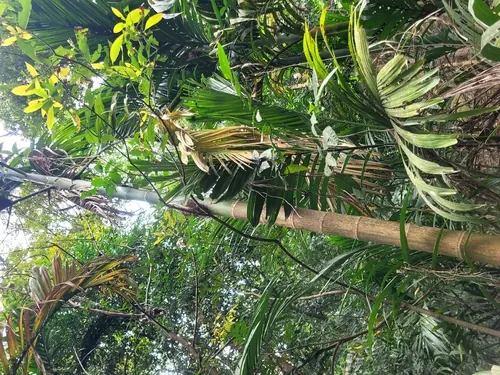
Check the species, plant part and complete botanical name together. A photograph alone cannot identify a harvest safely for consumption.
An illustration is not enough to identify a plant for consumption. Do not forage for a species based solely on this profile.
Uses & evidence
UNDERSTANDING THE USES
Properties & uses.
Pharmacopoeial material: seed (areca nut)
ANSM lists the seed and flags it as toxic. This is a toxicological reference with no recommended use.
The references do not establish a benefit. Lack of evidence is not assurance of safety.
Read the sourceDocumented carcinogenic hazard
IARC classifies areca nut as carcinogenic to humans (Group 1). It separately places the alkaloid arecoline in Group 2B; these assessments are not interchangeable.
This entry describes a risk or interaction, not a beneficial property.
Read the sourceThe traditional uses described are not clinical proof of effectiveness. Evidence for one preparation cannot automatically be applied to another.
Precautions before use
BEFORE ANY USE
Precautions & contraindications.
This guidance does not cover every individual situation. Missing information is not a guarantee of safety.
Contraindications & precautions
- PrecautionIARC classifies areca nut as carcinogenic to humans. No home use is recommended; this classification is not limited to use with tobacco.Source
- Insufficient dataThese sources are not a complete list of contraindications for every form.Source
Medicine interactions
- Insufficient dataThis dossier cannot establish compatibility with medication. A limited study does not replace an interaction review of the exact product.
Other retained warnings · review incomplete
These existing warnings remain relevant to consult. Their exhaustive reassessment is outside this targeted review.
Restrictions and precautions
- IARC classifies areca nut as carcinogenic to humans. No home use is recommended; this classification is not limited to use with tobacco.
- These sources are not a complete list of contraindications for every form.
Medicine interactions
- Interactions have not been sufficiently assessed in the sources retained for this notice; an incomplete assessment guarantees no compatibility.
Pregnancy, breastfeeding and children
No medicinal use is offered during pregnancy or breastfeeding; this dossier cannot establish safety in these situations.
No paediatric preparation or dose is offered in this notice.
“Reported” does not prove causality; “possible” may reflect indirect evidence. “None reported” means none in the cited source, not that all combinations have been studied. Do not stop a prescribed treatment based on this profile.
Adverse effects
- Established carcinogenic hazard for areca nut; this notice does not list every toxic effect.
Pregnancy & breastfeeding
No medicinal use is offered during pregnancy or breastfeeding; this dossier cannot establish safety in these situations.
Children & adolescents
No paediatric preparation or dose is offered in this notice.
If symptoms persist, worsen or are unusual, consult a healthcare professional. In an emergency, contact the emergency services.
Available evidence
EXPLORE THE EVIDENCE
The available evidence.
The documentary purpose is understanding hazard, with no therapeutic benefit proposed.
Whole nut and alkaloid
Mechanistic evidence for arecoline includes genotoxicity and oxidative stress; it helps explain hazard, not calculate a safe intake.
This entry describes a risk or interaction, not a beneficial property.
Read the referenceLimitations to keep in mind.
Do not include this seed in a recipe or chewing ritual.
Studies, findings & limitations
THE RESEARCH
What the research shows.
A laboratory or animal result alone does not demonstrate a benefit in humans. Each result must be read alongside the preparation studied and its limitations.
Whole nut and alkaloid
This entry describes a risk or interaction, not a beneficial property.
- Type of research
- IARC hazard assessment combining several evidence types, not a treatment trial.
- Preparation concerned
- Areca nut and arecoline assessed separately.
- Observed results
- The whole-nut classification concerns a human carcinogenic hazard.
- Limitations to consider
- A hazard classification does not predict an individual’s risk at a given dose.
What can we take from this?
A hazard classification does not predict an individual’s risk at a given dose.
Documentary review dated 09/10/2026. The references remain available to check the context.
Sources & last review
CHECKING REFERENCES
Sources for this profile.
- ANSM — French Pharmacopoeia, List A, January 2026, p. 5Accessed on 09/10/2026
- Kew POWO — Areca catechu L.Accessed on 09/10/2026
- IARC (2020) — IARC Monographs Meeting 128: Acrolein, Crotonaldehyde, and ArecolineAccessed on 09/10/2026
Image: Emily Chang · CC BY 4.0. View the original image and its licence. Image resized and converted to WebP.