
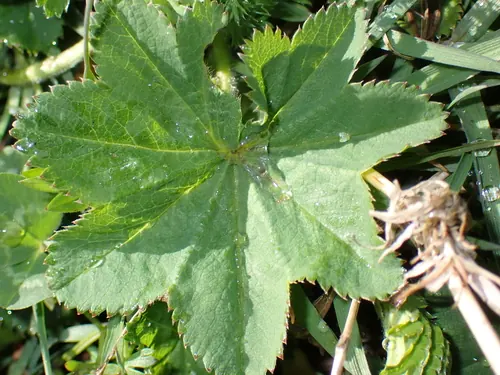
Identity & origin
BOTANICAL IDENTITY
The right name is the first step.
Perennial in the Rosaceae family. Recorded native range: Europe. The listed pharmacopoeial material is aerial parts.
Also known as: No synonyms listed.
Check the species, plant part and complete botanical name together. A photograph alone cannot identify a harvest safely for consumption.
An illustration is not enough to identify a plant for consumption. Do not forage for a species based solely on this profile.
Uses & evidence
UNDERSTANDING THE USES
Properties & uses.
Pharmacopoeial material: aerial parts
ANSM names Alchemilla xanthochlora while referring to the broad A. vulgaris concept. This notice keeps the precise species instead of pooling every result from the genus. This notice infers no therapeutic indication.
The references do not establish a benefit. Lack of evidence is not assurance of safety.
Read the sourceTannins and flavonoids: quality control
Tannin and flavonoid profiles varied with flowering stage. This is chemical analysis, with no measurement of menstrual, digestive or skin benefits in humans.
Laboratory or animal observation. A human benefit cannot be inferred from this finding alone.
Read the sourceThe traditional uses described are not clinical proof of effectiveness. Evidence for one preparation cannot automatically be applied to another.
Precautions before use
BEFORE ANY USE
Precautions & contraindications.
This guidance does not cover every individual situation. Missing information is not a guarantee of safety.
Contraindications & precautions
- Insufficient dataThis targeted audit does not provide a comprehensive contraindication review; this does not mean contraindications are absent.
Medicine interactions
- Insufficient dataThis dossier cannot establish compatibility with medication. A limited study does not replace an interaction review of the exact product.
Other retained warnings · review incomplete
These existing warnings remain relevant to consult. Their exhaustive reassessment is outside this targeted review.
Restrictions and precautions
- This botanical dossier does not establish medicinal-use safety. Anyone with a medical condition or taking medicine needs professional assessment of the specific product.
Medicine interactions
- Interactions have not been sufficiently assessed in the sources retained for this notice; an incomplete assessment guarantees no compatibility.
Pregnancy, breastfeeding and children
No medicinal use is offered during pregnancy or breastfeeding; this dossier cannot establish safety in these situations.
No paediatric preparation or dose is offered in this notice.
“Reported” does not prove causality; “possible” may reflect indirect evidence. “None reported” means none in the cited source, not that all combinations have been studied. Do not stop a prescribed treatment based on this profile.
Adverse effects
- This notice does not provide a complete adverse-effect assessment. Historical use alone cannot exclude toxicity.
Pregnancy & breastfeeding
No medicinal use is offered during pregnancy or breastfeeding; this dossier cannot establish safety in these situations.
Children & adolescents
No paediatric preparation or dose is offered in this notice.
If symptoms persist, worsen or are unusual, consult a healthcare professional. In an emergency, contact the emergency services.
Forms & how they are used
DOCUMENTED FORMS
One plant, several preparations.
Only forms documented in this profile’s sources are presented.
Studied preparation — documentary referenceAerial parts · Route: not recommended for self-treatment
Identified Alchemilla xanthochlora dried material among the tested batches.
Please note: Research description only; no self-treatment dose, recipe or duration is offered.
Read the sourceAvailable evidence
EXPLORE THE EVIDENCE
The available evidence.
This reference concerns a defined preparation of Alchemilla xanthochlora Rothm.. The result is experimental: a compound, an extract and a whole plant differ, as do a laboratory assay and a human benefit.
Constituents to know.
Their presence and quantity depend on the plant part and preparation.
- Tannins and flavonoids
- Measured in dried material; their profile varies with flowering.Read the reference
Tannins and flavonoids: quality control
Constituent identification informs batch quality; it does not by itself demonstrate a therapeutic effect.
Laboratory or animal observation. A human benefit cannot be inferred from this finding alone.
Read the referenceLimitations to keep in mind.
Constituent identification informs batch quality; it does not by itself demonstrate a therapeutic effect.
Studies, findings & limitations
THE RESEARCH
What the research shows.
A laboratory or animal result alone does not demonstrate a benefit in humans. Each result must be read alongside the preparation studied and its limitations.
Tannins and flavonoids: quality control — 1999
Laboratory or animal observation. A human benefit cannot be inferred from this finding alone.
- Type of research
- Comparative analysis of dried aerial-part batches from several Alchemilla species.
- Preparation concerned
- Identified Alchemilla xanthochlora dried material among the tested batches.
- Observed results
- Tannin and flavonoid profiles varied with flowering stage.
- Limitations to consider
- This is chemical analysis, with no measurement of menstrual, digestive or skin benefits in humans.
What can we take from this?
This is chemical analysis, with no measurement of menstrual, digestive or skin benefits in humans. Interactions, pregnancy and long-term use require separate assessment.
Documentary review dated 09/10/2026. The references remain available to check the context.
Sources & last review
CHECKING REFERENCES
Sources for this profile.
- ANSM — French Pharmacopoeia, List A, January 2026, p. 3Accessed on 09/10/2026
- Kew POWO — Alchemilla xanthochlora Rothm.Accessed on 09/10/2026
- Fraisse D et al. (1999) — [Standardization of the aerial parts of Alchemilla]Accessed on 09/10/2026
Image: Zeke Marshall · CC BY 4.0. View the original image and its licence. Image resized and converted to WebP.